
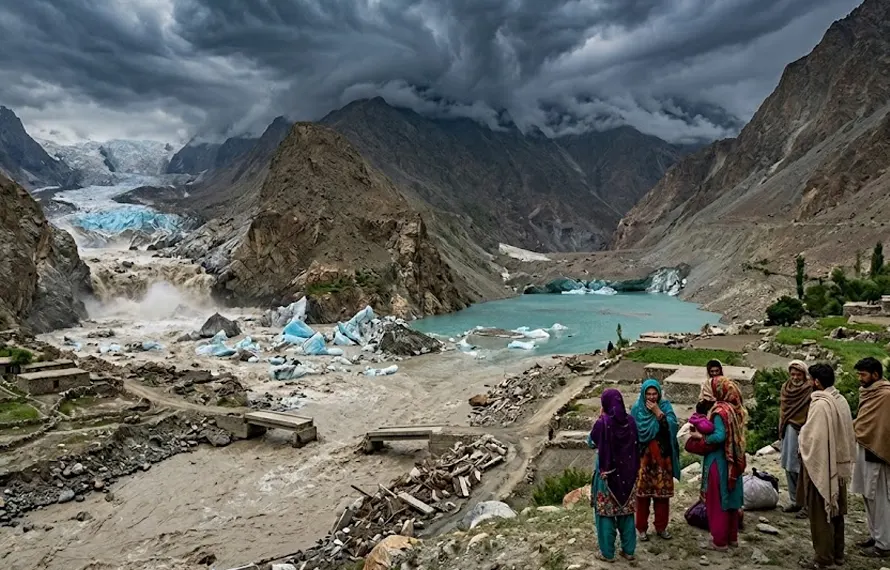

Imagine opening your front door at sunrise and hearing the mountains roar. Not thunder. Not an earthquake. A glacier collapsing somewhere above your village. Within minutes, a torrent of water, mud, and giant boulders races down the valley. Fields disappear beneath dark floodwaters. Roads vanish. Bridges collapse. Families run for safety, carrying children, elderly parents, and whatever possessions they can grab in seconds. For many communities in northern Pakistan, this is not a nightmare. It is becoming a reality.
When climate change is discussed in international conferences, the conversation often revolves around targets, negotiations, and technical jargon. But far from the air-conditioned halls of global summits, climate change has a very human face. It is the farmer watching years of hard work disappear underwater. It is the mother wondering where her family will sleep after a flood destroys their home. It is the child whose school is washed away by a disaster they played no role in creating. Nowhere is this injustice more visible than in Pakistan’s northern mountains, where ancient glaciers are melting at alarming speeds and entire communities are living on the front lines of a crisis they did little to cause.
The Day the Mountain Broke:
In the remote village of Pasu, nestled high in Pakistan’s Karakoram range, the morning began like any other. The sun slowly illuminated the peaks surrounding the Shisper Glacier, and life moved at its usual pace. Then came the sound. A deep, ominous rumble echoed through the valley. Moments later, a massive wall of muddy water burst from beneath the glacier and thundered downstream, carrying boulders the size of cars. A glacial lake had ruptured, unleashing what scientists call a Glacial Lake Outburst Flood, or GLOF.
Driven by rising temperatures, glaciers that once melted gradually are now losing ice at dangerous rates. As meltwater accumulates behind fragile natural dams made of rock and debris, entire lakes can suddenly burst without warning. When they do, destruction follows. Fields of wheat disappear in seconds. Bridges connecting isolated communities are torn apart. Homes are damaged or destroyed. Families flee to higher ground with little more than the clothes they are wearing. For many residents of northern Pakistan, these events are no longer rare disasters. They are becoming a recurring part of life.
Read More:GILGIT: Climate Change, Floods, and the Overlooked Mental Health Crisis
Paying the Price for a Crisis It Didn’t Create:
Pakistan is home to 7,532 glaciers, more than almost any country outside the polar regions. These glaciers feed rivers, support agriculture, generate livelihoods, and sustain millions of people. Today, however, they are shrinking. Research conducted by Pakistani climate experts shows that the Passu Glacier alone lost around 10 per cent of its area between 1977 and 2014 and continues to retreat by roughly four metres every month. Across northern Pakistan, glaciers have melted nearly ten times faster during the past decade than they did over the previous two centuries.
As glaciers retreat, new dangers emerge. Melting ice creates lakes that are often held back only by unstable piles of rock and sediment. Pakistan’s Ministry of Climate Change has identified more than 3,000 glacial lakes across Gilgit-Baltistan and Khyber Pakhtunkhwa, with dozens classified as highly dangerous and at risk of bursting. The consequences stretch far beyond mountain valleys. According to research published in Nature Communications, around two million Pakistanis are among the 15 million people worldwide threatened by glacial lake flooding.
The Year Pakistan Went Underwater:
Few countries have experienced a climate disaster on the scale Pakistan endured in 2022. Between June and October, the country received nearly three times its normal seasonal rainfall. In Sindh province, rainfall levels reached an astonishing 450 per cent above average. The result was catastrophic. Floodwaters submerged approximately one-third of Pakistan, covering an area comparable to the size of the United Kingdom. Rivers overflowed, roads disappeared, villages vanished beneath water, and millions were left stranded.
The human cost was devastating. More than 1,700 people lost their lives. Around 33 million people were affected or displaced, with over 20 million requiring urgent humanitarian assistance. More than two million homes were damaged or destroyed. Thousands of schools became unusable, while roads, bridges, and critical infrastructure were swept away. Livestock losses exceeded one million animals. Behind every statistic was a human story: a family without shelter, a farmer without crops, a child without a classroom, and an entire community forced to begin again.
The financial damage was equally staggering. Assessments estimated total losses and damages at roughly 30 to 40 billion dollars. Agriculture, the backbone of Pakistan’s economy and a source of livelihood for millions, suffered some of the worst impacts. The world promised support. At a United Nations-backed donor conference in 2023, countries pledged approximately 10 billion dollars to help Pakistan recover and rebuild. Yet by 2024, only a fraction of those commitments had materialized. Promises, however, do not rebuild bridges, and they do not bring back lives that have already been lost.
The Cruel Arithmetic of Climate Change:
The most troubling part of Pakistan’s climate story is not the scale of the disasters; it is the imbalance of responsibility. Pakistan contributes less than one percent of global greenhouse gas emissions. Yet it consistently ranks among the countries most vulnerable to climate-related disasters. Meanwhile, the world’s largest emitters continue to dominate global pollution.
China accounts for roughly 29 percent of annual greenhouse gas emissions, making it the world’s largest emitter. The United States contributes around 13 percent and remains the largest historical emitter since the Industrial Revolution. India ranks third, responsible for about 8 percent of global emissions, while the European Union, Russia, and Indonesia also contribute significant shares. Together, these major emitters are responsible for nearly two-thirds of the world’s greenhouse gas output.
The contrast could not be clearer. Communities in Pakistan are losing homes to floods, crops to droughts, and livelihoods to climate extremes, while contributing only a tiny fraction of the emissions driving those changes. This is not simply a climate crisis. It is a justice crisis.
The Politics of Delay:
Despite mounting scientific evidence, global climate action remains trapped in political calculations and diplomatic disputes. Governments continue debating who should act first, who should pay more, and who should bear responsibility. Meanwhile, the planet continues to warm. The science is clear, and the warnings are unmistakable. Yet while politicians negotiate, communities in Pakistan continue to face floods, heatwaves, droughts, and glacial disasters with increasing frequency. Nature does not wait for political consensus. Physics does not negotiate.
The clock is ticking. Scientists warn that if global temperatures rise by 4 degrees Celsius, glaciers worldwide could lose nearly half their ice by the end of this century. In Pakistan, more than half of today’s glacier-covered landscape could disappear if current pollution trends continue. Future flood risks could increase dramatically, exposing millions more people to displacement, economic hardship, and loss. These projections are not distant possibilities; they are warnings about a future that is already beginning to unfold.
Read More: KP Floods Expose Pakistan’s Climate Crisis
Why the Poorest Suffer the Most:
Climate change affects everyone, but it does not affect everyone equally. The poorest communities are often the least responsible for emissions and the least equipped to cope with their consequences. Many live in flood-prone regions, drought-affected areas, or fragile coastal zones. They often lack the financial resources, infrastructure, and technology needed to adapt.
For farmers, even a slight shift in rainfall can destroy an entire harvest. For families struggling to access clean water, higher temperatures mean longer journeys and greater hardship. For health systems already under pressure, floods and heatwaves bring additional disease, displacement, and suffering. Climate change does not create inequality; it magnifies inequalities that already exist.
A Warning From the Mountains:
The mountains of northern Pakistan are delivering a verdict written not by politicians, but by physics. The people of Pasu, Hunza, and Gilgit did not build the factories that fueled this crisis. They did not produce the emissions driving global warming. Yet they are losing their homes, their livelihoods, and sometimes their lives. Climate change is no longer a future threat. It is already here—in flooded villages, shattered bridges, ruined harvests, and millions of people struggling to rebuild after disasters.
The glaciers of northern Pakistan are sending the world a warning. The question is whether the world’s biggest polluters are willing to listen before more lives are swept away. The glaciers are melting. The clock is ticking. And nature will not wait for politics to catch up.
Leave a Reply