
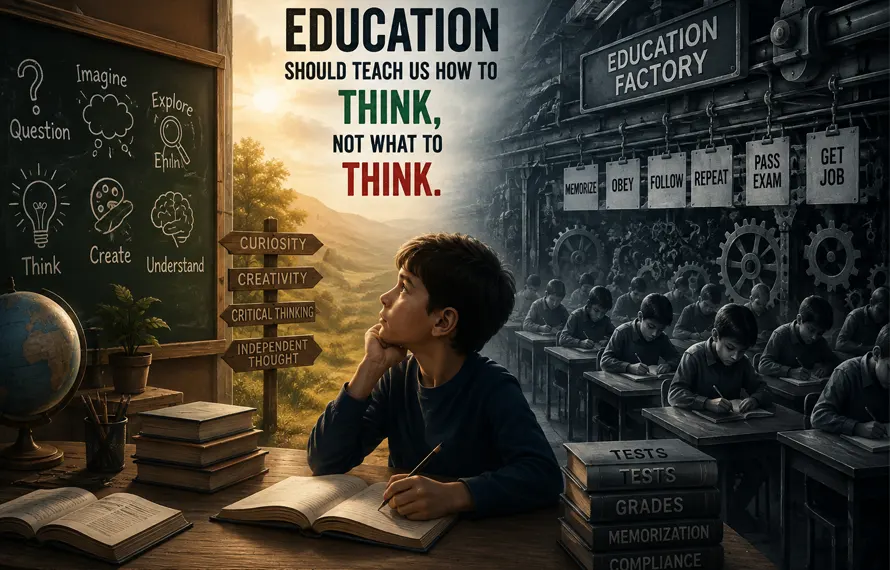

Ali was eight years old when he asked his teacher a question that nobody in the classroom expected.
“If Isaac Newton had never sat under that apple tree, would someone else have discovered gravity?”
The classroom fell silent.
The teacher looked at him for a moment and then said, “That’s an interesting question, Ali, but it isn’t part of today’s lesson. Let’s focus on what’s in the textbook.”
Ali never got the answer he was looking for. But something else happened that day. He slowly stopped asking questions.
Perhaps that is one of the biggest challenges facing education today.
Read More: Presidential or Parliamentary! What Does Pakistan’s Constitutional Journey Teach Us?
Children are born curious. They want to know why the sky is blue, why birds can fly, why people think differently, and why the world works the way it does. They don’t just want answers. They want understanding.
The true purpose of education was never simply to fill young minds with information. It was to teach them how to think, how to question, and how to discover. History’s greatest thinkers were not people who memorized every answer. They were people who refused to stop asking questions.
As the Industrial Revolution transformed societies, education also began to change. Growing industries needed large numbers of skilled workers who could read instructions, follow procedures, keep time, and perform tasks efficiently. Schools became more structured, more standardized, and more focused on producing a workforce that could meet the demands of a rapidly changing economy.
There is no doubt that this system brought many benefits. Education became available to far more people, literacy improved, and millions gained opportunities that previous generations never had. But somewhere along the way, many classrooms began rewarding the right answers more than thoughtful questions.
Students learned to remember, but not always to reason.
They learned to repeat, but not always to challenge.
They learned to pass exams, but not always to solve problems.
Imagine a classroom where a student asks, “Why do we solve this problem this way? Is there another method?” Instead of exploring the question, the reply is often, “Just learn this for the exam.”
That single sentence may help a student score marks, but it rarely helps them become an independent thinker.
The world has never been changed by people who simply followed instructions. Every great invention, every scientific breakthrough, and every revolutionary idea began with someone who looked at the ordinary and dared to ask, “What if there is a better way?”
Today, information is everywhere. Artificial intelligence can answer questions within seconds. The real value of education is no longer memorizing facts. It is learning how to evaluate information, think critically, solve problems, and make wise decisions.
Read More:Degree in Hand, Job a Dream!
Schools should not choose between knowledge and thinking. Students need both. They need facts, but they also need the freedom to question those facts. They need discipline, but they also need imagination. They need education that prepares them not only to earn a living, but also to understand the world they live in.
Perhaps the success of a school should not be measured only by how many students pass examinations.
It should also be measured by how many leave the classroom still curious enough to ask, “Why?”
Leave a Reply