
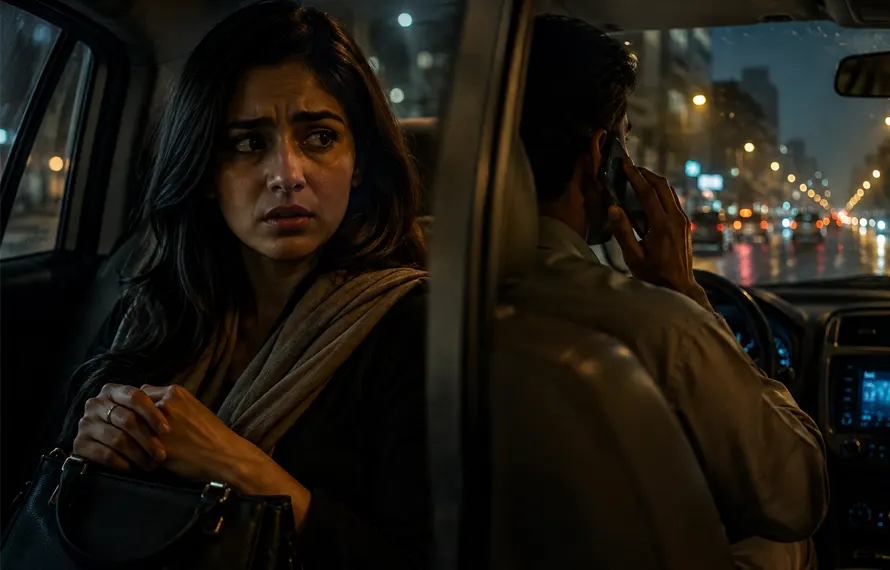
Fatima has been a working woman in Pakistan for over six years. She knows the streets, knows how to handle tense situations, and prides herself on being fearless. But last night, on a routine journey home, her heart was in her throat.
She had booked a ride through a popular rideshare app after a long day at the office. The moment she sat in the back seat, she noticed the driver was on a continuous, low-voiced phone call. Every few minutes, he would update the person on the line, whispering, “Haan, main ab F-8 pohnch gaya hoon… ab yahan se aagay nikal raha hoon…”(“Yes, I’ve reached F-8 now… moving ahead from here…”)
The constant, real-time location updates sent a cold chill down her spine. Sensing something wasn’t right, Fatima’s instincts immediately kicked in. She dropped her usual polite demeanor, sat up straight, and called him out directly, her voice firm and uncompromising: “Kisse baat kar rahe ho tum? Driving par dhyan do aur fuzool ki baatein band karo! Mujhe koi aam, bebus aurat mat samajhna!” (“Who are you talking to? Focus on driving and stop talking nonsense! Don’t take me for an ordinary, helpless woman!”)
She kept her eyes glued to the live map on her phone, hyper-alert to every single turn he took until the car finally pulled up to her house. She handled it like a boss, standing her ground with fierce courage. Yet the second she stepped inside her home and locked the door behind her, her hands were trembling, and she broke into a cold sweat.
That raw, lingering terror—even for a seasoned, confident woman—is the reality of navigating public spaces in Pakistan. Fatima’s story isn’t an isolated incident; it represents an invisible, exhausting mental tax that every Pakistani woman pays the moment she steps outside her front door. Before we even get into a car or step onto a bus, an automatic safety audit begins in our heads. We constantly calculate why a driver took a specific turn, whether our phones have enough battery to broadcast our live location to three different friends, and how quickly we can react if a situation turns dangerous.
To avoid these unnerving encounters, we routinely drain our bank accounts on self-imposed safety measures. We skip cheaper public transport or basic rickshaws and pay double for higher-tier, rated rides, turning a simple daily commute into a crushing monthly expense. When traveling to another city or managing out-of-town trips, we completely bypass ordinary budget hostels or cheaper commercial accommodations. Instead, we hunt down family-run guesthouses or verified family-oriented stays—paying a steep markup just to ensure a safe, respectable environment where we won’t be subjected to intrusive questions or unsafe corridors.
The steepest price we pay, however, isn’t measured in rupees. It is measured in the emotional fatigue of living in constant “battle mode.” Arriving at work or returning home physically and mentally drained from staying hyper-vigilant shouldn’t be the baseline requirement for being a working woman.
When a brave, experienced professional is left shaken to her core by a basic cab ride, it proves that safety in our country has been turned into a luxury feature rather than a fundamental right. Real freedom will only come when our streets, public transit, and accommodation sectors are held to genuine standards of accountability. Until our public spaces belong to everyone equally, millions of women like Fatima will continue to pay this invisible price—in money, anxiety, and sweat—just for the basic privilege of moving through their own cities safely.
Leave a Reply