
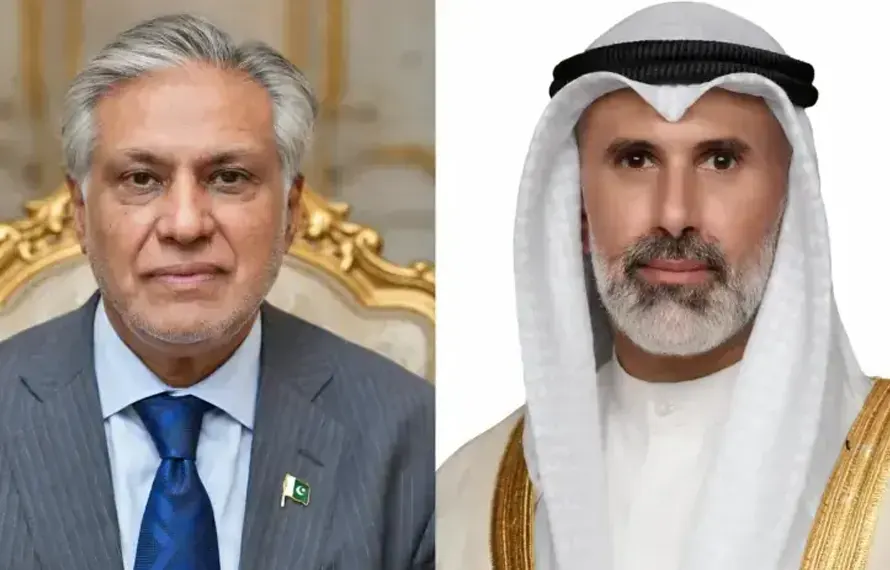
Deputy Prime Minister and Foreign Minister Ishaq Dar received a telephone call from Kuwait’s Foreign Minister Sheikh Jarrah Jaber Al-Ahmad Al-Sabah, during which the Kuwaiti dignitary extended felicitations to Pakistan on the signing of the Makkah Joint Defence Agreement between Pakistan, Saudi Arabia, and Turkiye, the Foreign Office (FO) stated on Monday.
According to the Foreign Office, the two leaders held discussions late on Sunday to exchange views on the overall regional situation, including occupied East Jerusalem. They also reviewed bilateral relations and matters of mutual interest, focusing on the follow-up to FM Jarrah’s recent official visit to Pakistan to further enhance bilateral cooperation and investment across key sectors, with both sides agreeing to maintain close engagement.
Briefing to Canadian Foreign Minister:
Earlier, Deputy Prime Minister Dar also held a telephonic conversation with Canadian Foreign Minister Anita Anand. The Foreign Office reported that both figures exchanged views on the regional landscape and the recently concluded Makkah Joint Defence Agreement.
During the call, Dar shared the core essence of the trilateral pact, emphasizing the shared resolve of Pakistan, Saudi Arabia, and Turkiye to actively contribute toward regional peace, stability, and security.
Deputy Prime Minister/Foreign Minister Senator Mohammad Ishaq Dar @MIshaqDar50 spoke late last night with Kuwaiti Foreign Minister Sheikh Jarrah Jaber Al-Ahmad Al-Sabah.
FM Jarrah felicitated the DPM/FM on the recent signing of the Makkah Joint Defence Agreement between… pic.twitter.com/CNCidV43nJ
— Ministry of Foreign Affairs – Pakistan (@ForeignOfficePk) August 10, 2026
Core Principles of the Makkah Joint Defence Agreement:
The historic defence pact, signed in Makkah on Friday, aims to reinforce collective deterrence among the three nations. Under its terms, an armed attack against any one of the signatory states will be treated as an attack against all. Addressing the nature of the pact, Dar clarified that the agreement remains open to any country in the region willing to uphold its foundational principles, following remarks by the Turkish foreign minister indicating that Egypt might join the pact.
Dar highlighted that the agreement is the culmination of years of detailed discussions and mutual coordination, driven by a unified desire to strengthen strategic cooperation against complex peace and security challenges. He explicitly affirmed that the accord does not abrogate or replace any existing bilateral or multilateral treaties that the signatory states hold with other countries or international organisations.
Aligning with UN Charter and Foreign Policy:
Reiterating the collective defence mandate, the Deputy Prime Minister noted that treating an attack on one as an attack on all aligns directly with the inherent right of individual and collective self-defence under Article 51 of the United Nations Charter. He reassured that the pact is purely defensive, targets no nation, and aims solely to advance regional prosperity and stability.
Deputy Prime Minister/Foreign Minister Senator Mohammad Ishaq Dar @MIshaqDar50 spoke today with Canadian Foreign Minister Anita Anand @AnitaAnandMP.
The two exchanged views on the regional situation, including the recently signed Makkah Joint Defence Agreement between Pakistan,… pic.twitter.com/jnVpLc0YJF
— Ministry of Foreign Affairs – Pakistan (@ForeignOfficePk) August 9, 2026
DPM Ishaq Dar reaffirmed that the Makkah Accord is open to regional nations committed to resolving disputes peacefully and through mutual respect. He added that the agreement fully aligns with the core pillars of Pakistan’s foreign policy as Islamabad continues to work alongside regional partners for lasting peace, conflict resolution, and mutual security.
Leave a Reply