

The Ghost in the Air: The Invisible Theft!

The Ghost in the Air: The Invisible Theft!
Erum Jamal Tamimi

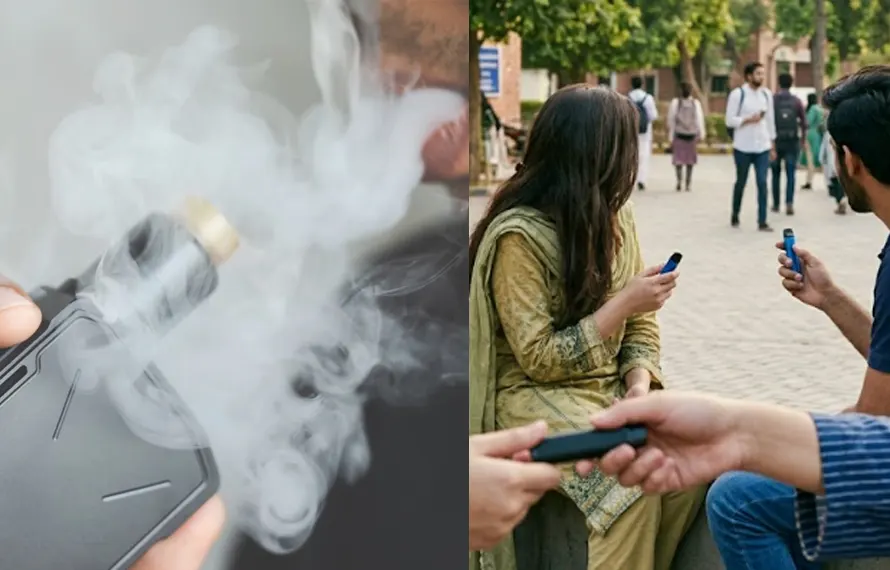
Outside a classroom block, the air carries the usual rhythm of a campus—footsteps, scattered conversations, the distant ring of a bell marking time no one seems to fully follow. But in one corner, attention narrows. A sleek, small device is passed between a group of students. There is no urgency, no secrecy, just routine familiarity. One of them takes a slow inhale. A thin, sweet-scented plume of vapor rises, hanging briefly in the air before dissolving into nothing. Then it moves again, casually offered, casually accepted, like it entirely belongs there.

No one interrupts, no one questions it. It is treated not as something unusual, but as a habit already seamlessly absorbed into the background of everyday student life.

A Quiet Trend Becoming a Visible Reality:

Over the past few years, vaping has staged a silent coup, transforming from a niche alternative for smokers into a defining lifestyle accessory for young people, especially across urban hubs. Walk into schools, colleges, universities, or local cafés, and the presence of these devices is undeniable. To many young users, they represent something modern, socially acceptable, and fundamentally cleaner than traditional cigarettes.The brilliant strategy behind their popularity lies in their design. They are small, stylish, easily concealed, and available in an endless array of flavors that seem practically tailored for a younger demographic. This calculated combination of aesthetics and perception has allowed vaping to spread like wildfire across student communities.

Yet, what appears to be a harmless, high-tech trend is increasingly drawing sharp, urgent warnings from health experts and environmental researchers alike.

The Nicotine Trap: Rewiring Vulnerable Minds:

At the core of the vaping phenomenon is a familiar culprit: nicotine. Despite the sleek packaging and fruity aromas, most vaping products deliver high doses of this heavily addictive chemical. Global health research warns that nicotine directly hijacks the brain’s reward system, a system that, in adolescents and young adults, is still very much under construction.The World Health Organization has repeatedly flagged that exposure to nicotine at a young age can permanently alter brain development, impair attention spans, and prime the brain for long-term addiction.

The real danger, however, is the illusion of safety. Because it doesn’t smell like smoke or look like a drug, the psychological barrier to trying it is incredibly low. What begins as mere curiosity or a casual social experiment can rapidly, and quietly, solidify into a daily dependency.

It is a subtle trap driven by social pressure and digital glamour, which lowers the fear of risk, triggers casual experimentation, and ultimately chains the youth to a routine addiction.

The Architecture of Normalization:

How does an addictive habit integrate into student life without resistance? Through the powerful mechanics of social and digital influence.In modern student environments, vaping is no longer a hidden vice, it is a social currency. It is shared between classes, used to punctuate study breaks, and often viewed as a quiet passport to belonging. In tight-knit peer groups, participation creates instant inclusion, while refusal can subtly create distance. This invisible pressure allows the habit to replicate without the need for active promotion.

This cycle is amplified by the digital world. Short-form videos, influencer lifestyle posts, and trendy aesthetics consistently frame vaping as relaxed, harmless, and sophisticated. When young people are exposed to these imagery loops daily, their innate sense of risk naturally erodes.

Read More:A Tale of Two Worlds: The True Cost of Modern Progress on the Roof of South Asia

The Invisible Mental Toll:

While aggressive marketing campaigns position vaping as a harmless escape, public health data tells a much more cautious story.Medical experts have increasingly linked consistent nicotine intake to a rise in anxiety, irritability, sleep disturbances, and fragmented concentration. For students already navigating intense academic pressure, these side effects don’t offer relief, they compound the stress.

Because long-term clinical studies are still catching up to the rapid evolution of these devices, health authorities emphasize that today’s youth are essentially participating in an unscripted, global experiment.

The Drain on the Pocket:

Beyond the hidden costs to health and nature, there is a very immediate, visible cost, the heavy financial drain. Vaping is far from a cheap hobby. In Pakistan, maintaining this lifestyle accessory means constantly spending thousands of rupees on disposable devices, pods, and flavored liquids.For university students living on tight budgets or pocket money, this turns into a significant monthly expense. Money that could be spent on education, fuel, or actual necessities is literally being turned into smoke, trapping young users in a costly cycle where they pay premium prices just to damage their own well-being.

The Toxic Footprint: A Deepening Ecological Crisis:

While the health and financial risks are slowly gaining attention, the environmental toll of vaping remains almost entirely shrouded in silence.The vast majority of trendy vape devices are disposable, built from a hazardous combination of non-biodegradable plastics, chemical-laden cartridges, and lithium-ion batteries. Consequently, they feed straight into electronic waste, which is currently the fastest-growing waste stream on the planet.

With the world generating over fifty million tonnes of e-waste annually, the unregulated disposal of millions of vapes adds a massive burden to global ecosystems. The plastic casings take centuries to degrade, breaking down into microplastics, while the lithium batteries can rupture in standard trash bins, sparking landfill fires or leaking toxic chemicals into surrounding soil and groundwater systems. What is packaged as a fleeting personal choice quickly aggregates into a permanent environmental scar.

The Culture of the Disposable:

Vaping is a micro-reflection of a much larger global crisis, the rise of a throwaway culture. The production of these electronic devices requires intense energy, international shipping drives up carbon footprints, and a total lack of specialized recycling infrastructure leaves local waste management systems heavily strained.Environmental experts stress that the core issue isn’t just the materials themselves, but the hyper-accelerated rate of consumption. It is a lifestyle model where short-term gratification is systematically prioritized over long-term planetary health.

Youth in the Pressure Cooker:

To truly address why vaping has taken root so deeply, we must look at the world young people are inheriting.Today’s youth face an unprecedented convergence of academic strain, highly competitive job markets, relentless digital comparison, and rising baseline anxiety. In an environment that feels constantly demanding, any habit that promises instant stress relief or immediate social alignment will inevitably spread rapidly.

Peer influence provides the initial spark, but the underlying emotional pressures are what sustain the flame.

Confronting the Illusion:

The fundamental challenge of the vaping epidemic is the profound disconnect between perception and reality. To the student holding the device, it feels modern, harmless, and completely normal. But beneath that glossy surface lies a triad of vulnerabilities, namely neurological addiction, mental health disruption, and an escalating ecological footprint.This gap between what is perceived and what is real is exactly what allows the trend to continue moving forward without friction.

Outside the classroom block, the student takes another slow inhale. The vapor rises once more, catching the light before vanishing into the air. But unlike the mist, the consequences do not disappear. They settle quietly into behavior, into brain chemistry, and into an environment that silently absorbs the toxic waste.

The question remains, hanging heavier than the vapor itself: Is this merely a harmless passing trend, or is it a compounding debt that a generation is leaving for the future to pay?

Leave a Reply

Your email address will not be published.