

The Iran conflict has done more than reshape Middle Eastern geopolitics: It has exposed deeper contradictions in contemporary political discourse and become a revealing test of the consistency with which universal principles are applied.
Governments have reacted largely as expected: Israel through the prism of security, Iran as the self-styled standard-bearer of “resistance,” the Gulf Arab states through the lens of Iranian proxy warfare and regional instability, and much of the Muslim world through the enduring centrality of the Palestinian cause. Whether or not one agrees with these positions, they are broadly rooted in history, national interest and political identity.
Yet the most revealing response has come not from governments but from sections of the liberal-progressive movement, particularly in Europe, North America and parts of the Global South. Many of these voices have long championed democracy, human rights, women’s rights and free expression. Opposing war and criticising the policies of the United States or Israel are entirely legitimate positions, but neither requires overlooking the conduct of another government. Universal principles lose their meaning when they are applied selectively. Political expediency may explain such selectivity, but it cannot be reconciled with claims of moral universality.
Iran’s domestic record is well documented. Political dissent has been tightly constrained for decades, with journalists, lawyers, labour activists and civil society figures repeatedly detained. The death of Mahsa Amini in 2022 ignited the Woman, Life, Freedom movement, the most significant challenge to the Islamic Republic in decades, met with mass arrests, internet shutdowns and harsh sentencing. Fresh protests in late 2025 and early 2026, driven by economic hardship, met an even harsher response — sweeping arrests, expanded internet restrictions and a sharp rise in executions, including of individuals accused of involvement in the unrest. For many observers, this confirmed that repression in Iran has deepened rather than eased.
Yet Iran has also built something politically formidable. Over four decades, it has constructed one of the most resilient political narratives in the contemporary Muslim world, cultivating genuine sympathy among many Shia communities and beyond through religious networks, state media and unwavering identification with the Palestinian cause. Supporters view it less through the lens of domestic governance than through its opposition to Israel and the United States. It is precisely this reservoir of political legitimacy that often outweighs concerns about Iran’s domestic governance in the eyes of many external supporters.
This explains why many Iranophiles continue to defend the regime despite mounting regional setbacks: Syria lost to Iranian influence after Assad’s fall, Hezbollah under pressure, Iraqi militias constrained, the Houthis increasingly isolated. Sectarian and ideological loyalty of this kind, like the wartime propaganda that accompanies it — exaggerated victories and battlefield narratives, a pattern seen from the Gulf War through Iraq and Afghanistan — is not hard to understand.
Progressive parties and intellectuals that champion universal human rights frequently struggle to apply the same standards consistently when conflicts involve governments positioned against the United States or Israel.
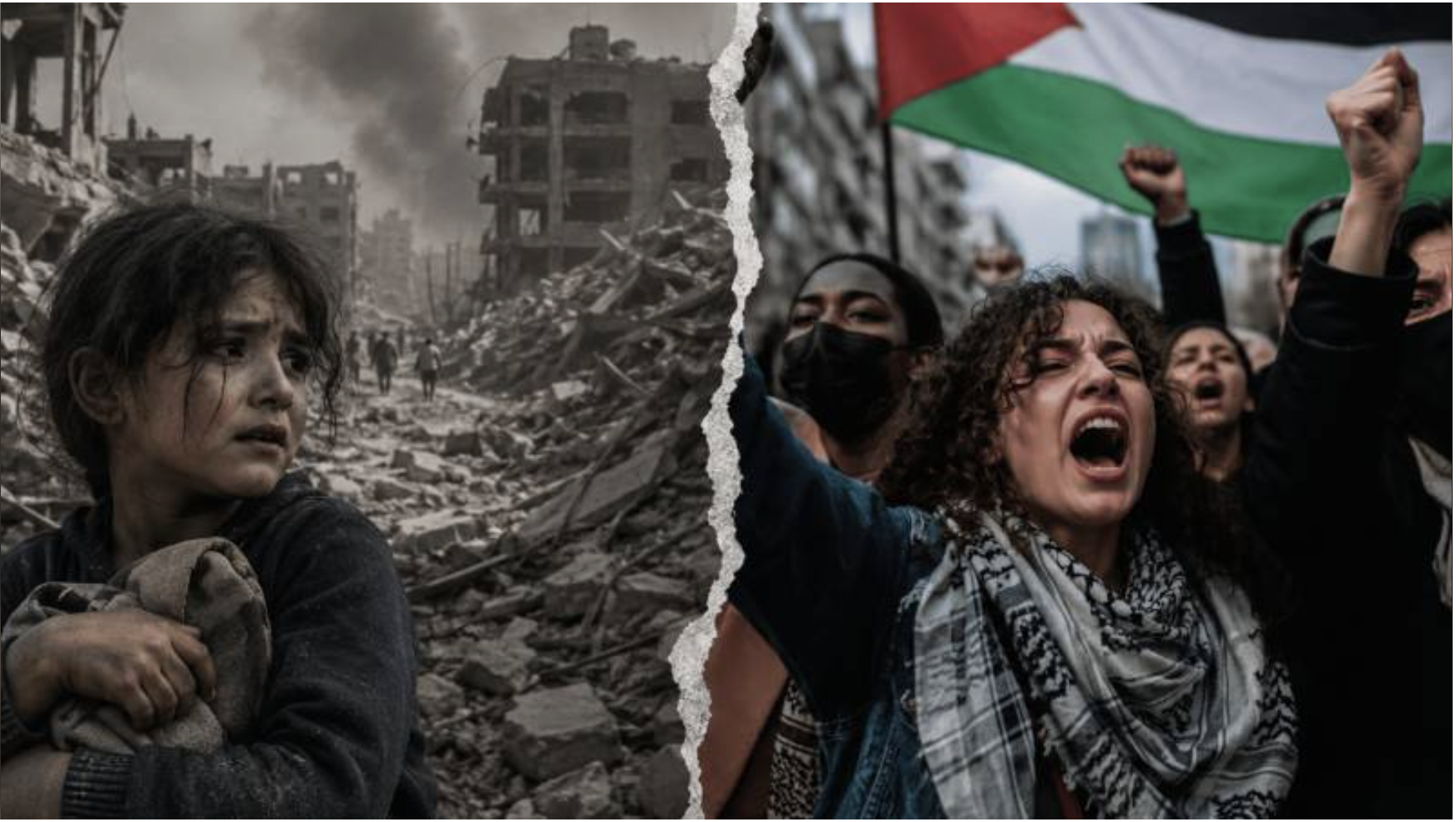
Palestine is central to understanding this phenomenon. For many progressive activists, the Palestinian cause has become the primary moral lens through which Middle Eastern politics is interpreted. That commitment, in itself, is entirely understandable. The difficulty arises when support for Palestine becomes so dominant that the internal character of governments opposing Israel receives comparatively little scrutiny. In such cases, geopolitical alignment begins to outweigh domestic accountability.
What is harder to explain, however, is the reaction of self-described liberal and progressive intellectuals. Many are Marxists, feminists, human rights activists or academics, often educated in or comfortably resident in Western democracies, who nonetheless direct much of their political energy at anti-Americanism. The pattern is not new: during the War on Terror, many of the same circles cast the Taliban as an anti-imperialist resistance movement despite its record on women and political repression, then grew notably quiet once the Taliban returned to power and imposed even harsher restrictions.
The common thread is not support for the Taliban or Iran as such, but a tendency to rank geopolitical opposition to the United States above scrutiny of domestic authoritarianism. In practice, anti-imperialism can become less a framework for analysing power than a substitute for analysing the character of the regimes themselves.
The same contradiction plays out today over Iran, where opposition to American intervention curdles into support, or at least apologetics, for one of the region’s most authoritarian regimes. But the two positions are not logically bound together — one can oppose American military intervention without supporting the Ayatollahs.
This is where a wider crisis on the Left becomes visible. Since the Soviet collapse, much of the traditional Left has lost its original ideological anchor, with anti-imperialism increasingly replacing class politics as its organising principle. pposition to American power has, in many cases, come to outweigh the consistent application of universal principles of democracy and human rights, which is why authoritarian governments hostile to Washington often receive a degree of sympathy rarely extended to governments aligned with the West.
The same tension is increasingly visible within mainstream progressive politics in Europe. Progressive parties and intellectuals that champion universal human rights frequently struggle to apply the same standards consistently when conflicts involve governments positioned against the United States or Israel. This inconsistency has become an increasingly easy target for political opponents, particularly as nationalist and conservative parties present themselves as speaking more plainly about questions of security and national interest.
The present conflict illustrates these contradictions particularly clearly. The US-Israeli strikes on Iran deserved condemnation — force used against a sovereign state, with regime change openly discussed — but Iran is not a passive victim in this conflict. Its revolutionary regime has pursued confrontation with the United States, Israel and its own neighbours for decades through proxies and ideological expansion, creating a broader strategic context that forms the backdrop to the war that followed the 2023 Hamas attack. Israel and its supporters have naturally pushed a pro-war narrative, while the MAGA wing opposes another foreign entanglement out of anti-interventionist instinct rather than any sympathy for Tehran
Europe’s position is the most exposed. Having already weakened its standing on human rights over Gaza, and while simultaneously backing Ukraine’s armed resistance, Europe cannot convincingly oppose one war while appearing selective about another — a contradiction sharpened by the rise of a nationalist Right at home just as traditional progressive parties struggle to offer a coherent alternative. The perception of selective moral standards has become politically damaging.
Gulf opinion, meanwhile, is far more layered than it appears from outside the region. It is sympathetic to Palestine but deeply wary of Iran after decades of proxy warfare in Iraq, Syria, Lebanon and Yemen, and newly alarmed by Iranian strikes on sovereign Gulf territory. Many in the Gulf also feel the United States has under-delivered on security despite hosting its bases, feeding a growing regional view that both Israel and Iran, each in its own way, threaten Gulf stability and sovereignty. Within Iran itself, and among Shia communities in Pakistan, Bahrain and elsewhere, the same war reads simply as American and Israeli aggression against a Muslim country, a narrative under which strikes on Gulf states hosting US forces are cast as legitimate resistance rather than aggression.
Anti-American sentiment across the Muslim world, sectarian loyalty and wartime propaganda are all understandable within their own political and historical contexts. What remains difficult to explain is why voices whose politics rests on universal human rights, women’s rights and democratic freedom continue to defend or excuse a regime whose domestic record contradicts each of those principles. Universal principles lose their meaning when they are applied selectively. Political expediency may explain such selectivity, but it cannot be reconciled with claims of moral universality. Does opposing Donald Trump or American intervention require supporting the Ayatollahs? Clearly not.
Leave a Reply