
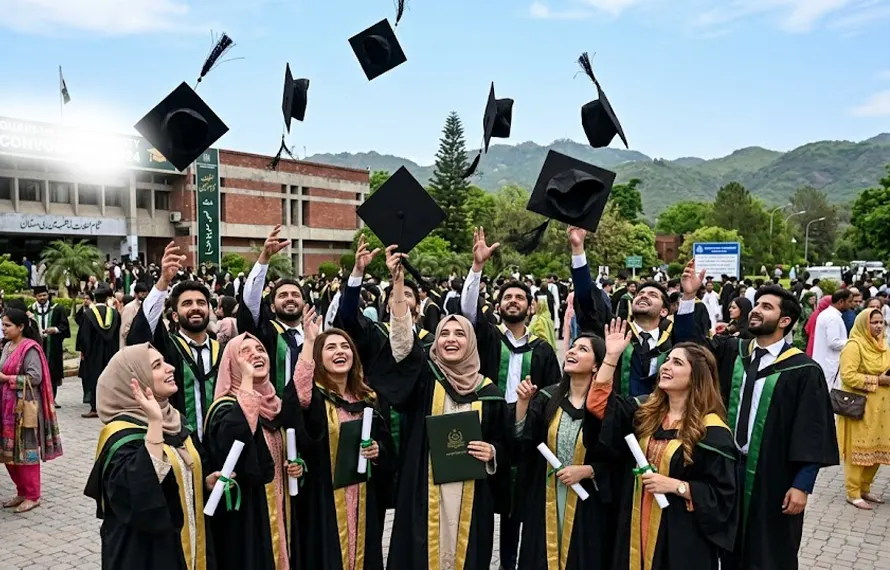

The transition from a university classroom to the professional world has become one of the most painful awakenings for young graduates in Pakistan. For decades, middle-class parents have operated under the illusion that a university degree is a golden ticket, a sacred promise that four years of struggle, semester fees paid from hard-earned life savings, and sleepless nights before finals will automatically be rewarded with a secure, well-paying career.
Instead, the reality that greets these graduates post-convocation is a crushing cycle of rejection. Every entry-level job posting demands prior experience, leaving fresh graduates trapped in a classic paradox of how to get experience if no one will hire them to gain it in the first place. The truth is stark that our universities have largely stopped being centers of professional preparation and have devolved into mere degree-printing factories.
Read More: SC Rejects Zahir Jaffer’s Review Plea, Upholds Death Sentence in Noor Mukadam Case
In many Pakistani institutions, higher education has been reduced to a superficial race for GPA points and perfect attendance records. Professors deliver lectures from decade-old presentation slides, forcing students to memorize theories that the global corporate sector abandoned years ago. Meanwhile, university career counseling centers hold a routine annual job fair, collect CVs in cardboard boxes, and consider their job done. When that same student steps into a modern interview room, they quickly discover that their perfect 4.0 GPA cannot answer the real-world questions employers are asking. The coding they studied doesn’t match production-level code, the financial models they memorized are completely outdated, and the marketing theory they mastered ignores the digital-first dimension of the modern economy.
To truly understand this crisis, we must look at how our current reality contrasts with international models. In Pakistan, the learning style remains heavily focused on rote memorization and GPA obsession, whereas modern systems in the US and Europe rely on project-based learning and case studies. Our work culture often views part-time student work as a social embarrassment, while global models treat earning while learning as a badge of pride. Furthermore, internships here have become a final-semester checkbox activity instead of the paid, structured corporate experiences students get every summer abroad. This leaves Pakistani graduates with a degree but zero experience, while their global peers graduate with both a degree and years of practical exposure.
Fixing this systemic failure requires urgent, coordinated action from our universities, parents, and students alike. Institutions must modernize their curricula immediately by integrating artificial intelligence, advanced digital marketing, and modern financial modeling. They need to bridge the industry gap by bringing corporate leaders into classrooms as guest lecturers and transforming internships into meaningful partnerships where students work on live projects.
At the same time, parents must redefine what success looks like and stop equating a high GPA with guaranteed career security. A student who cannot communicate or solve real problems is not ready for the market, regardless of their marks. It is time to normalize early work and support children who want to freelance, take up part-time jobs, or start small businesses during their studies, viewing it as critical preparation rather than a social taboo.
Ultimately, students must take full ownership of their professional journeys. Young people cannot afford to wait until graduation to build a resume; they must start acquiring practical, in-demand skills from their very first semester using online learning platforms. Building a professional digital presence on platforms like LinkedIn and actively networking with industry professionals is essential, as modern jobs are found through connections rather than newspaper classifieds. The university system will not save you, and your future is your own responsibility.
Pakistan’s youth possess immense talent and adaptability, qualities that shine clearly the moment they find themselves abroad. The same young person who struggled to find work locally will work long shifts in Dubai or manage demanding jobs in London just to get a foothold in their field, proving that innate ability was never the problem. The flaw lies within an outdated culture and an environment that refuses to evolve. We must shift our collective mindset from chasing paper degrees to acquiring real, actionable skills because our youth do not lack capability, they are simply held back by a system that refuses to change.
Leave a Reply