
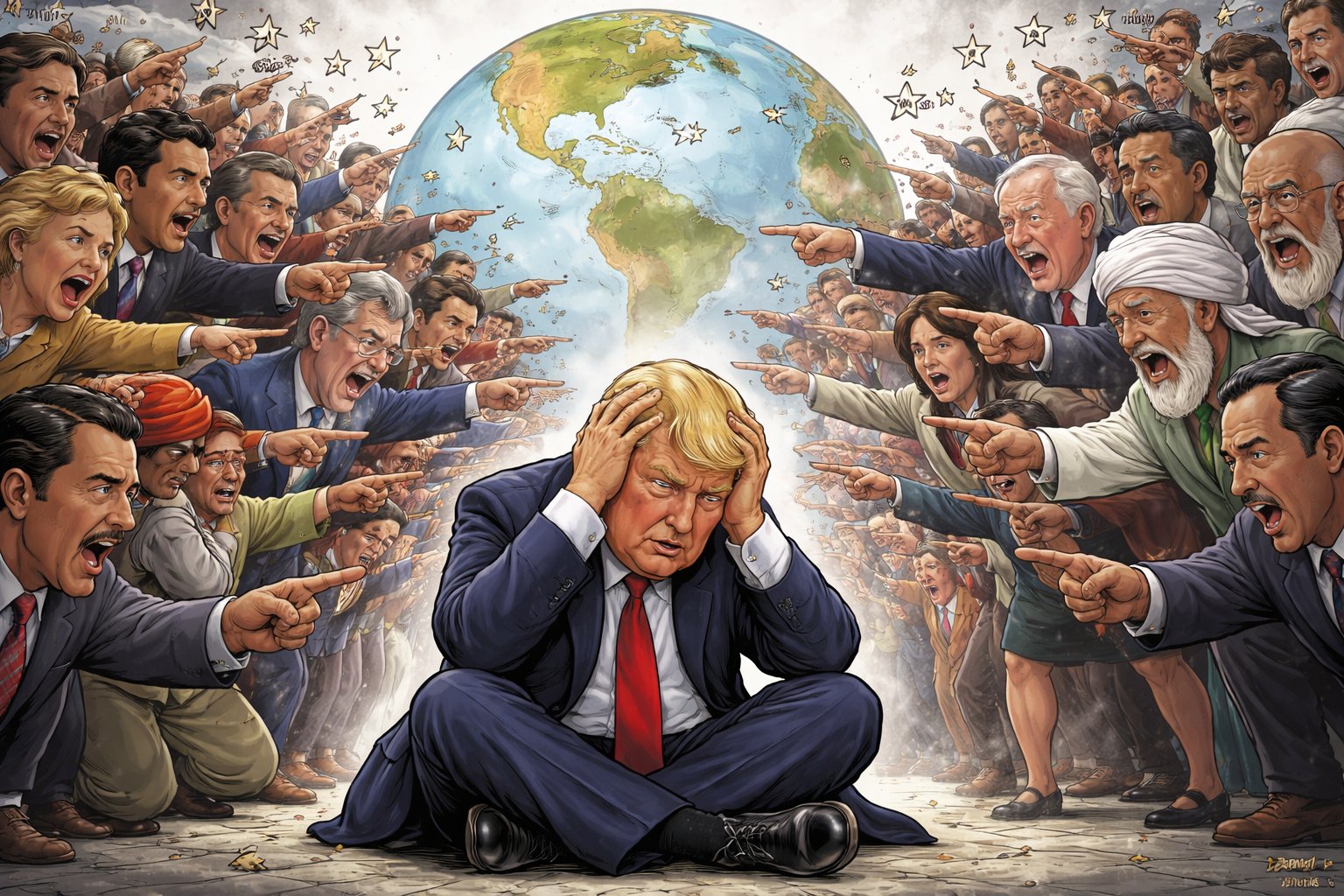
On the horizon of global politics, there emerge moments that transcend ordinary diplomatic disagreements and instead evolve into profound collisions of civilizational narratives, ethical principles, and the mechanics of power politics. The recent Iran-related crisis has unfolded as precisely such an extraordinary episode, wherein the President of the world’s most powerful nation, Donald Trump, appears firmly positioned with his characteristic assertive and confrontational strategic posture, while on the other side stands Pope Leo XIV of the Vatican, embodying a moral discourse that insists upon peace, reconciliation, and dialogue over the logic of war. This confrontation is not merely an exchange between two influential figures; rather, it reflects a deeper tension between power and morality, state interests and universal values, as well as militaristic strategy and religious ethics.
The escalating tensions surrounding Iran must be understood within a broader geo-political framework, one in which the intricate dynamics of the Middle East intersect with global power interests and ideological divisions. The United States, long accustomed to sustaining its global hegemony through both military and diplomatic instruments, continues to perceive the projection of force as an effective means of securing strategic objectives. President Trump’s rhetoric is emblematic of this worldview, wherein national security, strategic dominance, and immediate results are prioritized even at the potential cost of military confrontation.
In stark contrast, Pope Leo XIV presents a fundamentally different moral architecture. For him, war is not merely a source of human tragedy; it is also a manifestation of ethical decay. Drawing upon the teachings of the Gospel, he articulates a vision in which the essence of religion lies in the upliftment of humanity and the cultivation of mutual harmony, rather than its instrumentalization as a tool for power. His assertion that “we are not politicians, but messengers of peace” underscores the Vatican’s self-perception as not merely a religious institution, but a moral authority capable of awakening the global conscience.
A particularly critical dimension of this discourse lies in the attempt to invoke religion in support of militaristic narratives. The effort by President Trump and certain associates to provide theological justification for military action has not only unsettled religious circles but has also raised a fundamental question: should religion in modern politics serve as guidance or as justification? Pope Leo has firmly rejected such instrumentalization, emphasizing that employing the teachings of Jesus Christ to legitimize war is a profound distortion of the very essence of faith. This stance resonates not only within the Christian world but also offers a broader ethical framework applicable across religious traditions.
Another significant aspect of this confrontation concerns the evolving role of global religious leadership. Historically, the Vatican has played a mediating role in several international conflicts; however, in an increasingly polarized and interest-driven global order, the effectiveness of moral voices has become a complex and contested question. Nevertheless, Pope Leo’s consistent and unequivocal positioning demonstrates that ethical principles continue to retain relevance in global discourse, even if their immediate political acceptance remains limited.
On the other hand, the American leadership’s criticism of the Pope, dismissing his statements as detrimental to foreign policy, reflects a mindset in which dissent is equated with weakness. President Trump’s assertion that he disapproves of a Pope who disagrees with his policies reveals a broader tendency within contemporary global politics to favor unilateral perspectives over pluralistic dialogue. Yet this raises an essential question: does dissent truly weaken a state, or does it in fact serve as the foundation for balanced and responsible decision-making?
The Iran crisis has further reignited the debate over the ethical boundaries of war. According to international law and the United Nations Charter, war is recognized only as a last resort; however, in practical geopolitics, these principles are frequently subordinated to strategic imperatives. In such a context, religious and moral leadership seeks to restore equilibrium by restraining the unbridled use of force and advocating for peaceful resolution mechanisms.
Ultimately, this entire scenario underscores a defining crossroads in contemporary global history one path leading toward power, confrontation, and immediacy, and the other toward patience, dialogue, and enduring peace. The divergence between President Trump and Pope Leo XIV symbolizes these two opposing trajectories. One perspective maintains that problems are best resolved through force, while the other firmly believes that sustainable peace can only be achieved through dialogue and mutual respect.
In conclusion, the emerging confrontation surrounding the Iran crisis is not merely a transient political episode; it has evolved into a profound intellectual and ethical debate. Its implications may significantly influence the future direction of global politics. Should the world choose wisdom and moral responsibility over brute force, it may yet lay the foundation for a more peaceful and stable international order. Otherwise, the cycle of conflict may intensify further, with consequences that humanity at large will be compelled to endure.
Leave a Reply