
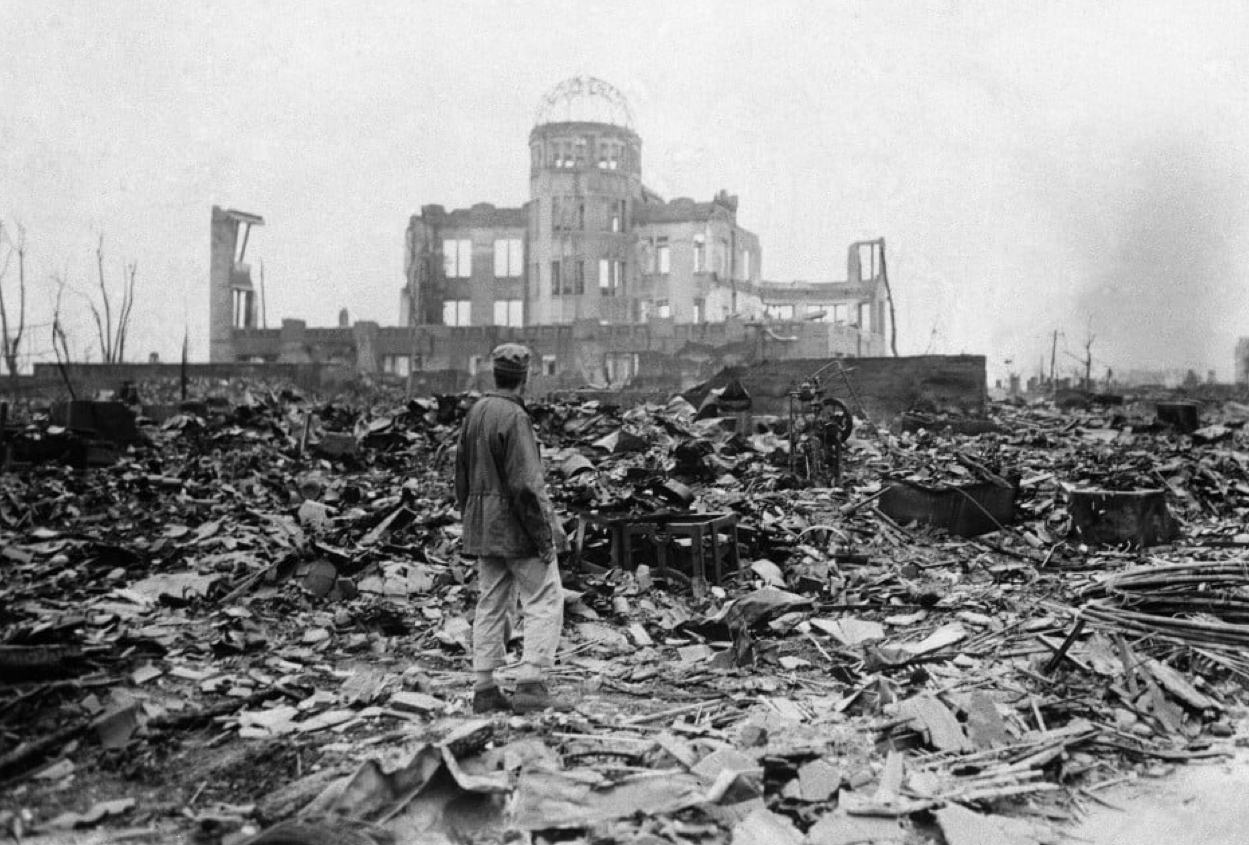
On the morning of August 6, 1945, the city of Hiroshima woke up to a familiar rhythm. Children made their way to school, shopkeepers rolled open their stalls, and homes echoed with the sounds of daily life. The air was warm, peaceful — ordinary. But above the clouds, a silence was building. It came in the form of a U.S. bomber named Enola Gay, carrying a new and terrible invention. Within minutes, that ordinary morning would be etched into history as one of its darkest.
The bomb it carried was called Little Boy, a grimly ironic name for the weapon that unleashed unimaginable devastation. At exactly 8:15 a.m., the bomb was dropped over the city. First came an intense flash of light — searing, blinding. Then came, a roar that shattered: windows, buildings, and lives. And then… silence. Nearly 80,000 people were killed instantly. The city was reduced to ashes. Clocks stopped. Shadows were burned into walls. Hiroshima was no longer a place — it was a wound.
Just three days later, on August 9, a second bomb — Fat Man — was dropped on the city of Nagasaki at 11:02 a.m. Another firestorm. Another wasteland. Another 39,000 lives lost in a matter of seconds. By August 15, Japan surrendered, bringing an end to World War II. But the cost of that surrender would be measured not just in numbers, but in the generational trauma and scars that followed.
Hiroshima and Nagasaki were not simply military targets. They were living, breathing cities filled with stories, families, dreams, and futures that were never allowed to unfold. In the aftermath, survivors — known in Japan as hibakusha — endured years of illness, social stigma, and painful memories. Radiation lingered in their bodies. Nightmares lingered in their minds. Many of them spent decades fighting not for revenge, but for peace.
In 2024, nearly 80 years after the bombs fell, the world took a small but powerful step in recognition. The Nobel Peace Prize was awarded to Nihon Hidankyo, an organization founded by survivors of the bombings. Their mission: to advocate for a world free of nuclear weapons, using their suffering not as a weapon, but as a warning.
At the award ceremony, Hiroshima’s mayor, Kazumi Matsui, issued a sobering message to the world. “We are drifting again,” he warned, “toward a world that sees nuclear weapons not as a threat, but as a shield.” His words struck a nerve. While over 70 countries have signed the 2021 Treaty on the Prohibition of Nuclear Weapons (TPNW), many global powers — including the United States, Russia, and Japan — have not.
Japan’s refusal to sign the treaty is particularly striking, given its history. The government maintains that the American nuclear umbrella is vital to its national security — a stance that stands in painful contrast to the lived experience of its own people in Hiroshima and Nagasaki.
In 2025, small peace demonstrations continued to echo through the streets of Hiroshima. Citizens held candles and posters, urging global leaders to prioritize peace over power. They marched not in anger, but in remembrance — not just of the past, but of the possibility of a different future.
And yet, the question remains. If you had the power to end a war with a single weapon — knowing it would kill thousands of innocent people — would you use it? For many, the answer is not so simple. Perhaps the war was won. But something greater may have been lost.
Hiroshima and Nagasaki are not just names in a textbook. They are questions — unanswered, aching, and eternal. They ask us not only what happened, but what we’ve learned. They challenge us to remember that true strength is not found in the size of our weapons, but in the depth of our compassion.
Because in the end, power means little… if it is not guided by a heart that knows how to feel.
Leave a Reply