
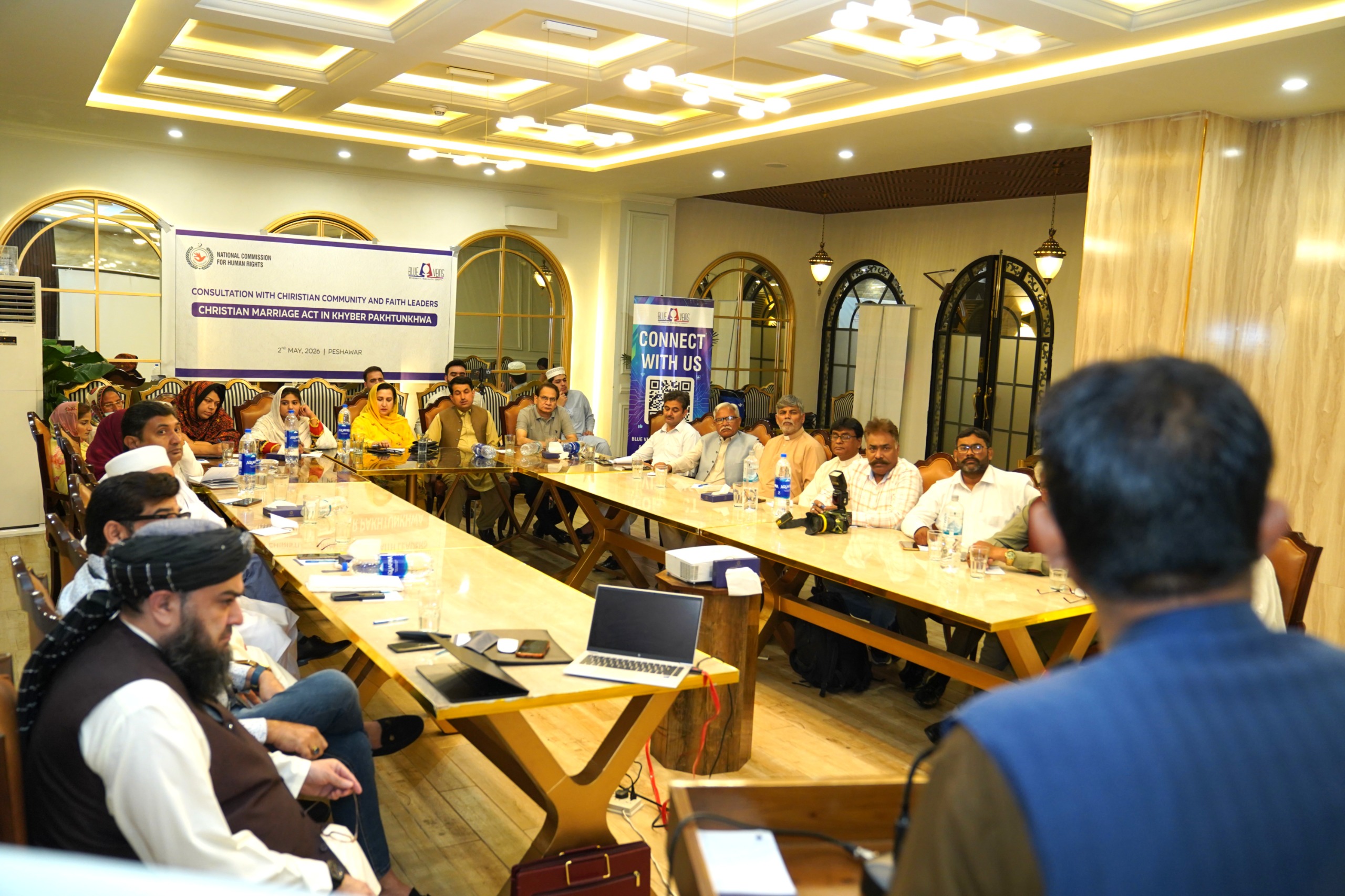
A provincial consultation on the Christian Marriage Act was organized in Peshawar by the National Commission for Human Rights in collaboration with Blue Veins, bringing together clergy members from different churches, women, girls, human rights activists, media representatives, members of the Provincial Assembly, legal experts, and representatives of minority communities to discuss the urgent need for comprehensive provincial legislation on Christian marriage and family laws in Khyber Pakhtunkhwa.
The consultation served as an important platform for dialogue and reflection on the outdated 1872 Christian Marriage Act and the growing challenges faced by the Christian community in matters related to marriage registration, appointment of registrars, delegation of authority, and legal recognition of marriages according to Christian faith and traditions.
During the consultation, minority rights activist Mr. Haroon Sarab Diyal presented a detailed overview of the Christian Marriage Act of 1872, explaining its historical background, key provisions, applicability challenges, and implementation gaps. He highlighted that despite the existence of the law, its enforcement remains weak and inconsistent, creating serious practical difficulties for Christian families across Khyber Pakhtunkhwa. He further emphasized the longstanding issues regarding the appointment of marriage contractors and registrars, lack of delegated authority for marriage registration, and the absence of a localized legal framework responsive to the current social and legal realities faced by the Christian community, particularly women and girls.
Participants expressed concern that the colonial-era legislation no longer adequately addresses the contemporary needs of the Christian population in the province. Heated discussions and emotional reflections emerged during the consultation, as participants shared their lived experiences, legal barriers, and concerns regarding the absence of a comprehensive and faith-sensitive legal framework. It was unanimously agreed by all participants that Khyber Pakhtunkhwa should introduce its own comprehensive provincial legislation on Christian marriage and related family matters.
Participants stressed that the proposed law should be firmly grounded in Christian beliefs, biblical teachings, and religious values related to marriage, contracting, ceremonies, and family life, while also ensuring alignment with constitutional protections, human rights principles, and international legal standards.
Speaking on the occasion, Mr. Wazir Zada, Focal Person to the Chief Minister of Khyber Pakhtunkhwa on Minorities Affairs, stated, “The Christian community has the constitutional right to family laws that respect their faith, dignity, and identity. The provincial government acknowledges the importance of this issue, and such consultations are essential to ensure that future legislation reflects the aspirations and religious values of the community.”
Mr. Rizwanullah, Coordinator at the National Commission for Human Rights, reaffirmed the institution’s commitment to minority rights and legal reform. He said, “The National Commission for Human Rights remains committed to supporting marginalized and minority communities in strengthening their legal protections and ensuring that their family laws are responsive, inclusive, and rights-based.”
Mr. Qamar Naseem from Blue Veins emphasized the importance of inclusive consultations and community ownership in the legislative process. He stated, “This consultation is part of a broader effort to ensure that the voices of Christian women, girls, clergy, and community representatives are heard and respected. Any future legislation must emerge through meaningful dialogue and reflect both faith values and the current realities faced by the community.”
Father Joseph John also emphasized the importance of broad-based community engagement before finalization of the proposed legislation. He stated, “It is extremely important that all churches, denominations, and community representatives are taken on board during this process. The proposed legislation should emerge through consultation, reflection, and consensus within the Christian community to ensure its acceptability and effectiveness.”
Participants collectively expressed their confidence in the ongoing consultative process being facilitated by Blue Veins and the National Commission for Human Rights and reiterated their commitment to actively contribute to the development of the proposed legislation. They pledged to continue providing recommendations, technical input, and community feedback to help ensure that the future law remains firmly aligned with Christian faith principles, constitutional guarantees, international human rights standards, and the contemporary social and legal needs of the Christian community in Khyber Pakhtunkhwa.
Leave a Reply