
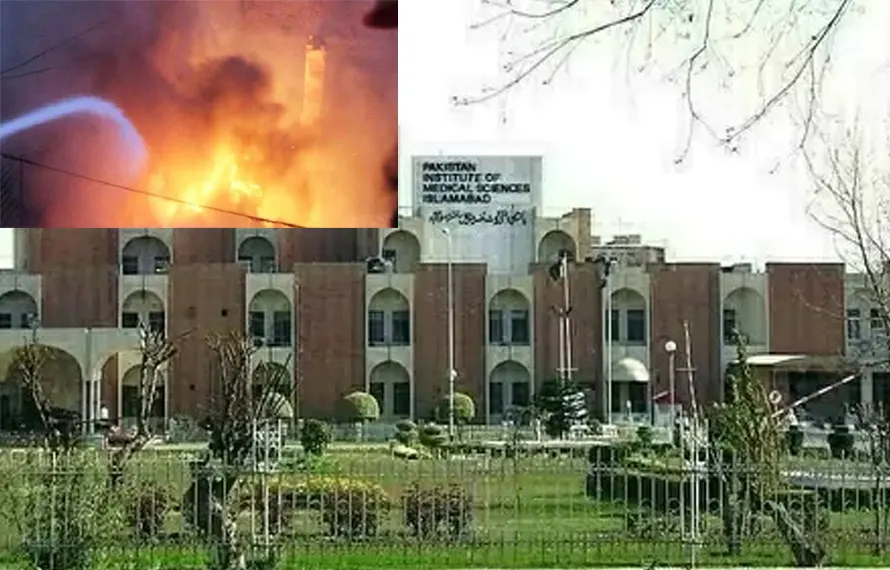

Imagine stepping into a public sanctuary of healing, handing your fragile, hours-old newborn to trained specialists, only to receive a charred blanket and a summons for DNA matching. On August 26, 2026, this horrifying reality shattered the lives of fourteen families inside the Neonatal Emergency Ward of the Pakistan Institute of Medical Sciences (PIMS).
It took only a few terrifying minutes for an air conditioner compressor explosion and an electrical short circuit to turn the third floor of the Mother and Child Health (MCH) Center into a trap of smoke and flames. High-pressure central oxygen pipelines acted like blowtorches, accelerating the blaze across the room in seconds. Out of fifteen newborns fighting for their lives in incubators, only one survived thanks to a quick-thinking doctor.
This was not a tragedy born of bad luck, but a disaster built on systematic failure and administrative neglect. The federal capital’s largest public hospital operated its most delicate unit without working automatic sprinklers, functional heat sensors, or operational alarm systems. Reports indicate the neonatal ward had been temporarily shifted into an unsafe wing directly exposed to ongoing structural construction, violating basic critical care safety protocols. When the fire broke out, the total absence of trained emergency teams and clear evacuation routes left post-surgery mothers and terrified staff helpless as smoke filled the corridors.
The official machinery responded with its standard crisis routine. Prime Minister Shehbaz Sharif suspended Federal Health Secretary Aslam Ghori on the spot and ordered a high-level inquiry. A multi-member committee led by former Interior Secretary Shahid Khan—comprising Establishment Secretary Dr. Barrister Nabeel Awan, Maj. Gen. (R) Dr. Khurshid Utra, and the Deputy Commissioner of Islamabad—was given forty-eight hours for an interim report and five days for final findings.
Yet, as the Pakistan Medical Association (PMA) pointed out, routine suspensions and temporary probe committees rarely yield permanent structural change. In our administrative system, initial anger cools down, reports are filed away, and systemic hazards remain unaddressed until the next calamity strikes.
When state-run incubators in the heart of Islamabad fail to keep newborns safe, it exposes a profound breach of public trust across the entire healthcare system. Moving forward, the government must enforce independent third-party safety audits across all government health facilities and hold high-ranking administrators criminally accountable. Those fourteen infants never got the chance to grow up, and treating their deaths as a temporary scandal rather than a catalyst for complete reform makes the rest of us complicit in the next avoidable catastrophe.
Leave a Reply