
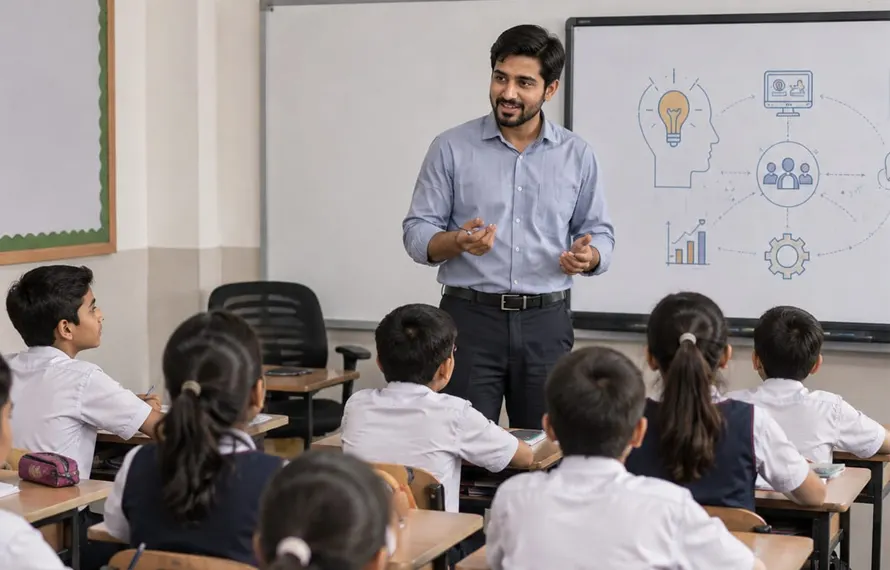

The chalk hovered an inch from the blackboard, frozen in mid-air. For five agonizing seconds, the silence inside Classroom 6-B was deafening. Sir Tariq, a veteran educator of fifteen years, felt a sudden, cold prickle of embarrassment behind his neck. He was facing an unprecedented classroom standoff—not from a unruly student, but from an eleven-year-old sixth-grader named Bilal. Bilal had just asked whether indoor crops could perform photosynthesis using artificial LED light spectrums, a cutting-edge concept he had watched on a 3D animation before breakfast. Trapped by a decade-old textbook that only mentioned natural sunlight, Sir Tariq slowly lowered his hand, swallowed his pride, and forced the only defense he had left: “Bilal, that is outside the syllabus. We discuss page 42 first.”
That single, tense moment captures the quiet crisis unfolding across Pakistan every single morning. Millions of children cross school gates, stepping out of 2026 reality and traveling decades back in time. Outside, they ask AI search engines questions and digest global innovation in seconds. Inside, they sit before blackboards while teachers read line-by-line from worn textbooks using methods from a bygone era. We voice endless frustration over why our children struggle to think critically or why university graduates face unemployment. We debate multi-billion-rupee education budgets, brand-new school facilities, and free tablets, yet we routinely ignore the single human being standing directly between all those investments and the child: the teacher.
Read More:Makkah Defense Pact: PM Shehbaz Sharif Welcomes President Trump’s Support
Ask any parent paying steep tuition fees or any taxpayer funding public education about the real issue today. Parents watch their children memorize twenty pages of definitions to clear an examination, only to realize those same children cannot draft a basic job application or solve a real-world problem. The root cause is simple: teachers are rarely given the opportunity to keep learning. If an educator’s professional development ends the day they receive their degree, how can we expect them to prepare a child for an unpredictable world? We would never trust a surgeon who hasn’t updated their medical knowledge in fifteen years, nor would we step onto an aircraft with a pilot who never returned for simulator training. Yet, we expect teachers to shape millions of young minds without continuous, modern instruction.
When we observe education systems that successfully prepare youth for modern careers, the distinction comes down to how teachers are supported. In Finland and Singapore, teacher development is a continuous, weekly practice where educators are given dedicated time to research new strategies, master digital tools, and collaborate on lesson plans. In Estonia and Japan, classrooms center on practical inquiry, training teachers as mentors who guide children how to think and question rather than what to memorize. In contrast, the typical classroom in Pakistan continues to rely on one-way lectures, leaving students unprepared for modern workplaces that demand adaptability, communication, and digital literacy.
Pakistan’s combined education budgets amount to hundreds of billions of rupees. But concrete walls cannot explain a complex concept, and a digital screen cannot notice when a quiet child has stopped understanding the lesson. To transform this landscape, teacher development must address real classroom realities directly. First, we must eliminate useless, one-off annual workshops and replace them with in-classroom mentoring, where master trainers observe live lessons and offer continuous feedback. Second, we must provide targeted training that arms teachers with practical strategies to manage large groups, support struggling readers early, and accommodate different learning speeds. Third, training must focus on helping teachers guide students to analyze information, spot fake news, and use digital tools ethically, rather than forcing teachers to compete with search engines for raw facts.
Teacher training is too often treated as a secondary expense or an administrative luxury, when it is actually the core driver of educational success. Research consistently demonstrates that spending even a single school year with an effective, well-supported teacher yields lasting benefits for a student’s learning, employment, and future earning potential. Blaming teachers is never the answer; an educator cannot fix a broken system without leadership, proper resources, and room to grow. If Pakistan genuinely wants to prepare its youth for tomorrow, we must stop using yesterday’s methods. The most powerful educational investment is rarely the newest building or the latest piece of technology—it is the person standing at the front of the room.
Leave a Reply