
In recent days, the South Asian media landscape has been shaken by a surge in conflicting reports, censorship, and disinformation, underscoring a deeper crisis that extends beyond national borders. Pakistan ranked 152 while India secure 151 position (out of 158) in freedom of press globally.
On April 22, 2025, a tragic terrorist attack occurred in the Baisaran meadow near Pahalgam, Kashmir, resulting in the deaths of 26 individuals, primarily Indian tourists, and injuring 17 others.
In the aftermath, the Indian government attributed the attack to Pakistan-based militant groups, specifically Lashkar-e-Taiba, and launched “Operation Sindoor,” on the night of 7th May, conducting air strikes on in Pakistan and Pakistan-administered Kashmir. Pakistan denied involvement and condemned the strikes, labeling them an “act of war”. As tensions rise between India and Pakistan, the role of the press, social media regulation, and public discourse have all come under intense scrutiny.
False Alarms and Sensationalism
On the night of May 8, many Indian media outlets particularly television channels aired sensational claims suggesting that India had launched massive strikes across Pakistan. The coverage claimed that the major cities such as Karachi, Lahore, Islamabad and Peshawar has been destroyed by the Indian Airforce and Pakistan’s army chief arrested.
The channels were using big screens showing Pakistan’s map and identifying places destroyed by the Indian forces. The channels used old and AI fabricated footages to prove their arguments.
A senior journalist Barkha Dut claimed that a Pakistani pilot is in Indian custody but there was no evidence of this claim nor the Indian government verified this claim. This tweet was viewed by 2.2M. This kind of misinformation can create chaos across the borders.

These stories quickly spread through newsrooms and social platforms, prompting celebratory responses from parts of the Indian public and diaspora.
However, these claims were later found to be unverified or outright false. No official confirmation supported these assertions, and international media outlets did not validate them. This wave of misinformation not only caused confusion but also led to a public backlash.
Influential Indian voices openly criticized the media’s conduct such as Prof. Ashok Swain wrote on his X-account, “Indian media is the worst enemy of people of India.”
Investor Basant Maheshwari admitted he was misled: “I feel sad not because of tweeting but because I (wrongly) believed what I saw.”

Educator Nitish Rajput remarked, “If the news media tells me it is raining, I will look for my sunglasses.”
Another verified X-account Mohit Chauhan criticized an x-army officer who is spreading misinformation.
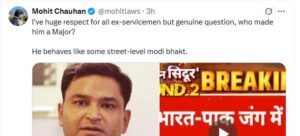
These comments reflect a deepening trust deficit between Indian media and its audience, raising serious questions about editorial standards and media ethics.
The Media Ethics are at risk
Media ethics demand accuracy, accountability, and fairness, especially in times of conflict. The recent Indian coverage falls short of these standards. The decision to air unverified claims without clear sourcing reflects a preference for sensationalism over responsible reporting.
An Indian audience criticized and called Indian channels a ”jock” and ”a shame”
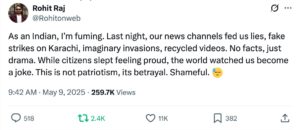
But the concern is not limited to misinformation. The Indian government has taken steps that many view as attempts to manage public perception rather than encourage transparency:
Over 8,000 accounts on X (formerly Twitter) were requested for blocking by the Indian government, including international media organizations, journalists, and celebrities.
The @Muslim Instagram account, run by Ameer Al-Khatahtbeh and followed by 6.7 million users, was banned in India at the government’s request. This account often covered global Muslim issues and conflict narratives.
While the government claims national security concerns, the sheer breadth of these bans including voices outside India, raises concerns about suppression of independent or international perspectives.
Simultaneously, India has banned 16 Pakistani YouTube channels, alleging that they spread misinformation. However, no public legal proceedings or specific evidence have been presented to support these claims, raising further transparency issues.
Pakistan’s Media Landscape: Accountability Amid Crisis
Across the border, the Pakistani response presents a contrast in several areas:
The Pakistan Telecommunication Authority (PTA) blocked 16 Indian YouTube news channels, 31 specific videos, and 32 websites, issuing a public statement that identified the content as misleading and harmful to national interests.
Despite certain limitations, Pakistani media outlets have continued to cover the ongoing conflict, including reports on civilian casualties and infrastructure damage.
Additionally, there has been active public discourse in Pakistan questioning the military’s response, especially regarding drone and missile interceptions with the military offering responses to some of these concerns, reflecting a degree of public accountability that has been largely absent in India’s current media environment.
That said, Pakistan’s media environment is not without its challenges. X was blocked since Feb, 2024 but opened on May 7. A Long-standing concerns about censorship and the safety of journalists remain, and both nations must improve press freedoms to better serve their citizens.
Unanswered Questions Demand Attention
In both countries, the role of the media should be to ask difficult but necessary questions. However, in India, several pressing issues remain unquestioned by the authorities and media:
• What is the status of the Pahalgam terror attack investigation?
• Has the Indian government responded to Pakistan’s claims that five Indian fighter jets, including three Rafales, were shot down on May 7—a story reported by international outlets such as CNN, BBC, and Reuters?
• Why are media outlets not scrutinizing these claims or the government’s silence?
The only media which raised these questions was, ‘’The Wire’; which was banned by the Indian Government today. According to a statement issued by The Wire, says, ‘’It is a clear violation of the constitutional guarantee of freedom of the press’’. A functioning media must not only report but also probe, verify, and challenge narratives—regardless of political sensitivity.
A senior Pakistan journalist Hamid Mir disclosed in a TV program, that Narender Modi has a personal problem with senior journalist Karan Thapar a news presenter and interviewer working with The Wire. He also demanded the Pakistani government to give access to Pakistani media for the coverage of Boarder areas in Kashmir to ensure transparency.” This is important to mention that The government gave access to media organizations to those places hit by the Indian strikes.
No, ‘’ism’’ in ‘’Journalism
The events of the past week illustrate how both misinformation and suppression threaten the credibility of the press in the region. Whether it’s the unchecked sensationalism seen in parts of Indian media or the need for greater press freedom in Pakistan, the region stands at a media crossroads.
Media is responsible to provide accurate and objective information to the public and make the state accountable. Media must be held to account not for patriotism or profit, but for objectivity.
Recent developments between India and Pakistan have highlighted a dangerous surge in media misinformation, censorship, and disinformation, particularly in the Indian media landscape. Sensational and later debunked, claims about attacks on Pakistani cities and military infrastructure were widely circulated, leading to public panic and criticism from Indian citizens and public figures.
At the same time, India banned over 8,000 accounts on social media, including international media organizations, and restricted platforms like @Muslim on Instagram. Pakistan also responded by blocking 16 Indian YouTube channels, but it publicly cited disinformation as the reason.
While Pakistani media allowed coverage of civilian impacts and encouraged public discourse including questioning the military’s preparedness, Indian media largely avoided accountability or scrutiny of key unanswered issues such as the Pahalgam terror attack or alleged jet losses.
The unchecked spread of misinformation undermines peaceful diplomacy, erodes public trust, and can lead to miscalculations. It also severely damages media ethics, public credibility, and democratic institutions.
Leave a Reply