
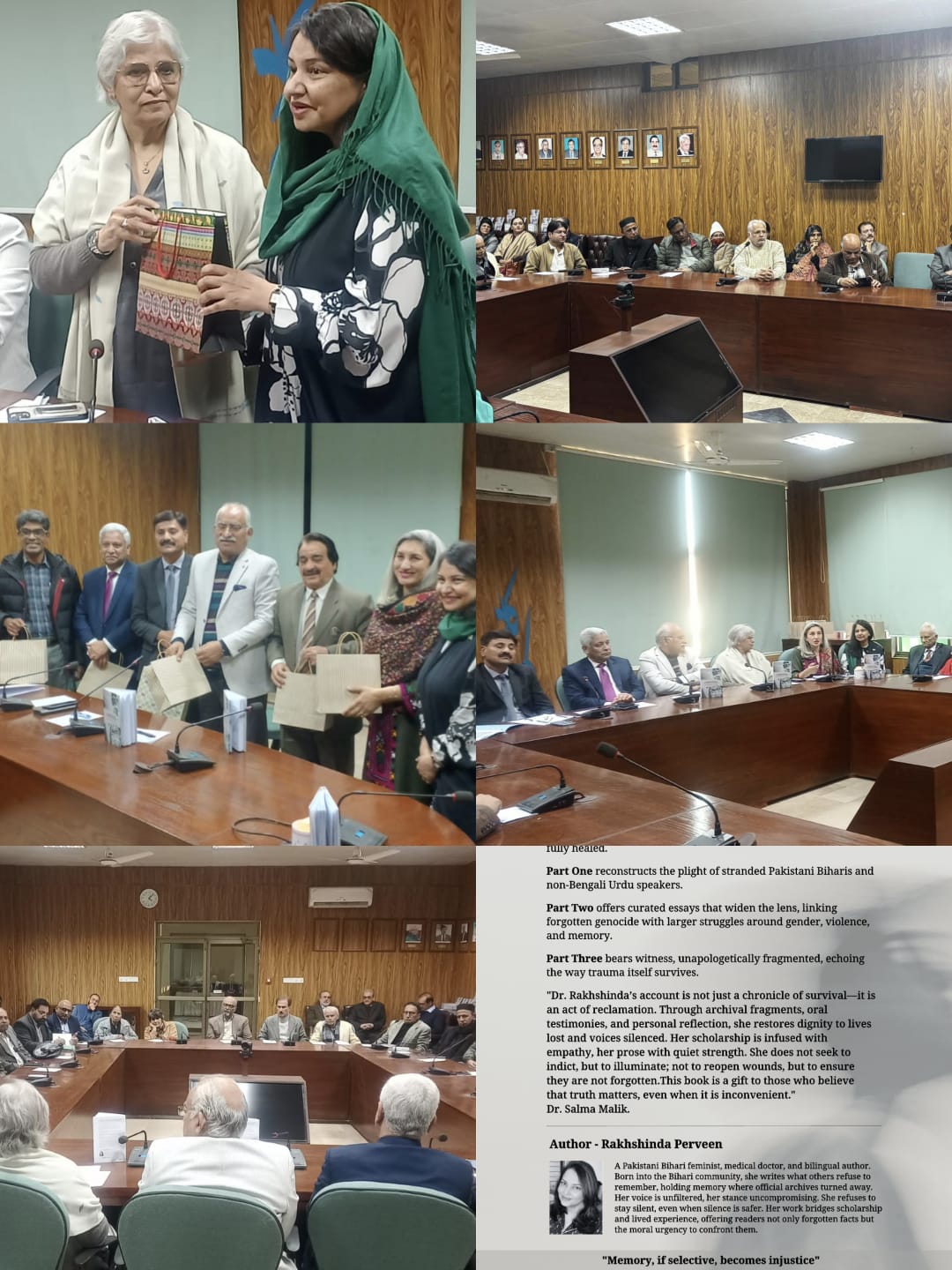

After nearly 15 years of nonfunded singular advocacy for creating empathy for the “stranded, shunned, and stigmatized” patriots whom I also call the Abandoned Pakistanis—I decided to take another intellectual risk. This time, the risk involved inviting thinkers and empaths in the twin cities into a reflective and meaningful conversation inspired by my most recent book, The Abandoned Pakistanis: 1971, Betrayal, and Statelessness – A Personal Chronicle of Forgotten Genocide, Selective Memory, and the Fight for Recognition.
Through the lens of lived experience and literary testimony, the session sought to illuminate forgotten narratives, challenge selective memory, and create space for voices historically left unheard. I believe deeply in collaboration. Therefore, I conceptualized a pioneering dialogue through creativeangerbyRakhshi, a platform committed to intellectual courage, creative dissent, and truth-telling in difficult spaces.
The Islamabad dialogue on this “sensitive issue” was unique in many ways. Organized at the Pakistan Academy of Letters (PAL), it became a venue where the painful if not criminal silence surrounding many aspects of this tragedy was finally broken. This event aligns with the Academy’s mission to advance literary scholarship, encourage deep historical reflection, and support dialogues that foreground marginalized communities and silenced histories.
Broad Objectives of the Event
1. To create a shared space where literature becomes a bridge between lived history and national consciousness, prompting deeper moral and social reflection.
2. To encourage interdisciplinary understanding by bringing together perspectives from security studies, defence analysis, and human-rights scholarship.
3. To foster empathy-driven conversations around the experiences of stranded and stateless Pakistanis.
4. To motivate writers, scholars, and intellectuals to acknowledge, engage with, and speak about this overlooked community in their work.
It was a humble beginning, and it is hoped that if such dialogues are sustained and expanded, the following desired outcomes may be achieved:
1. Strengthened collaboration between experts in security, defence, history, and human rights, fostering holistic engagement with the issue.
2. Renewed literary and academic interest in stories that have remained on the margins of mainstream discourse.
3. Greater awareness and sensitivity regarding the plight of abandoned and stateless Pakistanis.
4. A collective commitment to raising informed voices and integrating these narratives into public, literary, and policy conversations.
About the Book
The Abandoned Pakistanis: 1971, Betrayal, and Statelessness chronicles the lives of those who stood by Pakistan but were written out of its narrative the Urdu-speaking Biharis who became stateless after 1971.
• “I felt compelled to write it because we cannot move forward as a nation by erasing uncomfortable truths.”
• “It is dedicated to my late father, Professor Nazeer Siddiqi, and to the quiet martyrs—both from our families and from the frontlines—who remained loyal yet forgotten.”
• “This book is not only about the past; it is about how history flows into the present, and how some people continue to be treated as collateral, erased from policy, media, art, literature, and public conscience.”
• “It is not a catalogue of assaults or an attempt to quantify trauma. It is a historical and human-rights narrative about abandonment, betrayal, and statelessness. Like many other episodes of injustice—German soldiers in WWII, Belgian atrocities in the DRC, or today’s horrors in Sudan—the suffering of the Biharis was never fully documented, and that silence is itself part of the story.”
Why Read This Book?
Because it:
• revisits a twisted and biased history through an intersectional lens—connecting gender, class, identity, and displacement.
• carries personal histories that bring human texture to forgotten political events.
• helps us understand today’s Pakistan—from Balochistan to Bajaur—through echoes of what was left unresolved in 1971.
• revives patriotism with purpose while inviting honest self-reflection.
• speaks of an unacknowledged genocide without denying the pain endured by Bengalis of former East Pakistan.
• questions the myths of easy reconciliation and exposes what silence has cost us.
• amplifies missing voices—the stranded, the stateless, the forgotten—and their ongoing struggle for dignity.
• demands remembrance, not revenge; and repatriation, not rhetoric.
Participants and Panel
I am fortunate that more than 60 individuals from diverse walks of life and age groups filled the Committee Room of PAL. The panel (in reverse alphabetical order) consisted of:
1. Prof. Dr. Nazir Hussain (Guest of Honour & Chair)
Distinguished Professor of International Relations; former Dean, Faculty of Social Sciences; former Director, School of Politics and IR, Quaid-i-Azam University.
2. Prof. Dr. Najeeba Arif (Chair/President)
Chairperson, Pakistan Academy of Letters; eminent scholar, creative writer, critic, and researcher specializing in archival studies.
3. Prof. Munir Fayyaz (Moderator)
Poet, translator, critic, educationist, and broadcaster; Secretary, Halqa Arbab-e-Zoq, Islamabad.
4. Mr. Hameed Shahid (Chief Guest)
Internationally renowned short story writer, novelist, and literary critic; recipient of the Tamgha-e-Imtiaz (2016).
5. Dr. Salma Malik (Guest of Honour)
Associate Professor, Department of Defence and Strategic Studies, Quaid-i-Azam University.
6. Dr. Saif Malik (Distinguished Speaker)
Brigadier (Retd.) Dr. Saif Malik, TI(M); Former Director, NDU and founding Director, India Study Centre, ISSI.
Audience Profile
The event brought together some curious minds from civil society, passionate writers, forward-thinking intellectuals, youth leaders, feminists, and journalists committed to dialogue and social change.
Author’s Impressions
1. The thoughtful remarks, gracious engagement, and moral clarity offered by the panel added immense value to an issue long neglected in our collective memory.
2. Their presence and the presence of an august audience lent visibility, authenticity, and urgency to the plight we sought to highlight.
3. Many attendees later shared how deeply the insights resonated with them, and how the discussion opened new ways of understanding this human tragedy.
4. As the first woman Chair of PAL, the support extended by Prof. Najeeba Arif carries profound meaning not only for me but for many women striving to claim intellectual spaces in Pakistan.
5. Prof. Nazir summed up my book through Mustafa Zaidi’s verse: “Main kis ke haath par apna lahu talaash karoon?”
6. Dr. Salma Malik who wrote the powerful preface called the book a befitting tribute to my father and to all families and frontline defenders who made immense sacrifices.
7. Dr. Saif Malik described it as an important addition to the literature on the subject, and notably from a feminist perspective.
8. Many attendees viewed the book as an act of great courage.
9. Some suggested that literature and poetry are “ not deficient” on this topic; I clarified that the deficiency is not in the literature on 1971 as a whole, but in the treatment of this particular community’s marginalization.
10. Mr. Hameed Shahid read a deeply moving and personal piece entitled “متروک ہم وطن اور رخشندہ پروین کی دردناک چیخ” and highlighted the ordeals of stranded Pakistanis as well as the amnesia prevalent in our literature.
I remain grateful for the encouragement and dignity extended to this humble initiative. Thank you for your time, generosity, and solidarity. It truly made a difference.
Download free copies:drrakhshinda.mystrikingly.com
creativeangerbyrakhshi.com.pk
Disclaimer:
All speakers and participants joined the event in their personal capacities; their views do not necessarily reflect the institutions with which they are affiliated.
About the Author in her own words :
“I am a published bilingual author whose work blends narrative and reflective creative nonfiction with autoethnographic elements. Her writing on 1971 and the plight of her community resists easy categorization. It is not memoir though my family’s story runs through it. It is not academic history though it is rooted in research and testimony. It is not pure activism though every word demands action. It is a personal chronicle in the truest sense: one person’s insistence on holding truth in the face of institutional erasure. Call this what you will testimony, chronicle, evidence, plea. I call it necessary. This is not a memoir: I am not the subject. This is not a history book: history has already been written by those who benefited from forgetting. It may not fit any established genre. What it is: an advocacy work tracing more than half a century of patriotism punished, pitiless politics, and remembrance removed. “
Leave a Reply