
• Says Tehran unlikely to accept the deal Washington wants, demands its surrender; threatens to bomb Oman over Hormuz
• Iran rejects 60-day deadline, says it will not bow to ultimatums; warns of ‘precise’ military response to break US naval blockade
• UN calls for return to talks, restraint as regional conflict spreads; Pakistan, Qatar and Europe continue diplomatic efforts
• Houthis claim strike on Saudi military vessel in Red Sea
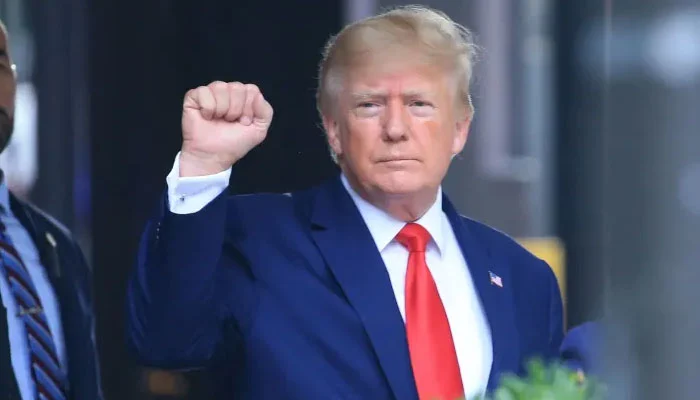
WASHINGTON: President Donald Trump said on Monday that the United States would not seek an extension of an interim memorandum of understanding with Iran, arguing that Tehran would not accept the kind of agreement Washington considers necessary to end the months-long conflict.
Speaking to reporters and during a phone interview with Fox News, as a 60-day negotiation period linked to the June agreement expired, Trump called on Iran to abandon the fight entirely. “They should put up the white flag of surrender,” he said.
The interim agreement, signed on June 17, had initially called for an “immediate and permanent termination of military operations on all fronts” and created a 60-day framework for talks over Iran’s nuclear programme, sanctions relief and broader security arrangements.
But the fragile arrangement quickly deteriorated. Disputes over maritime access and navigation rights in the strategic Strait of Hormuz intensified tensions and Trump declared on July 7 that the agreement was effectively “over”.
The US president insisted on Monday that domestic political considerations were not influencing his approach, dismissing suggestions that his stance was linked to the upcoming November congressional elections. “Midterms have nothing to do with my thinking,” Trump said.
In Tehran, however, officials rejected Washington’s interpretation of the agreement and disputed the existence of any meaningful 60-day deadline.
Iranian foreign ministry spokesman Esmaeil Baghaei said the timeline had no practical significance because, in Tehran’s view, the US had already violated the terms of the memorandum.
“There is no item regarding a 60-day deadline in the text of the memorandum, and the Islamic Republic of Iran never formulates its policies under pressure, ultimatums, or time constraints,” Baghaei said.
He argued that the agreement had only created a window to explore discussions on sanctions and nuclear issues, with the possibility of extending talks.
According to Baghaei, diplomatic efforts by Pakistan, Qatar and several European countries had continued, but the main obstacle remained what he described as Washington’s “mindset, miscalculations and insistence” on failed policies.
Earlier, Trump reiterated his central objective in a post on Truth Social, saying the US’ priority remained preventing Iran from obtaining a nuclear weapon.
“The number one Goal is, and always will be, that Iran cannot have, in any way, shape, or form, a Nuclear Weapon,” he wrote.
The dispute was further complicated by conflicting claims over behind-the-scenes diplomacy. A spokesperson for Iran’s Islamic Revolutionary Guard Corps rejected US suggestions that backchannel communications were still active.
Brigadier General Hossein Mohebbi dismissed those claims as “merely fantasies caused by the delusions and nightmares resulting from defeat and desperation in the war”.
Tensions also spilled into the region’s maritime corridors, with Trump issuing a sharp warning over Oman’s involvement in separate discussions with Tehran regarding the Strait of Hormuz.
“If Oman gets in the way, we’ll bomb the s*** out of them,” Trump told Fox News.
Oman and Iran have been holding talks aimed at establishing a framework for maritime passage through the strategically vital waterway, which handles a significant share of global energy shipments.
Iran, meanwhile, warned that the failure of diplomacy could trigger a wider military confrontation. A senior Iranian official told Reuters that Tehran had shifted its posture from defensive preparations to a “fully offensive” position.
“Iranian entities must be prepared to escalate tensions in the Strait of Hormuz and wider region,” the official said, adding that Iran was prepared to take “difficult decisions” if negotiations failed.
The official warned that Tehran would launch a “timely and precise” military response to break what Iran described as a US naval blockade.
The confrontation appeared to intensify further after Iranian media reported that an Emirati-owned tanker had been detained near Qeshm Island in southern Iran while attempting to pass through the Strait of Hormuz.
Iran’s semi-official Fars news agency reported that vessels travelling through the waterway were required to use Iranian-designated routes, pay service fees and receive official approval.
Meanwhile, the United Nations called on both sides to step back from confrontation and return to negotiations as a 60-day deadline for reaching a broader agreement approaches.
UN spokesperson Stephane Dujarric said Secretary-General Antonio Guterres’ position remained unchanged since the beginning of the conflict on February 28, arguing that there was no military solution.
“His message is the same, which he’s been delivering since the start, which is there is no military solution to this conflict,” Dujarric said.
He urged Iran and the US to resume talks aimed at reaching a peaceful and lasting settlement while lowering the increasingly hostile rhetoric.
The wider regional crisis continued to spread beyond the Gulf. In Yemen, the Houthis claimed responsibility for missile strikes targeting a Saudi military landing ship and four escort vessels near the Red Sea port of Mokha, close to the Bab el-Mandeb Strait.
Houthi military spokesman Yahya Saree said the attacks were part of the group’s naval blockade campaign.
Yemeni government military sources said missiles had struck areas around the strait and a government military facility, while independent reports indicated that the commercial vessel involved had been undergoing maintenance and was not operating normally.
Leave a Reply