
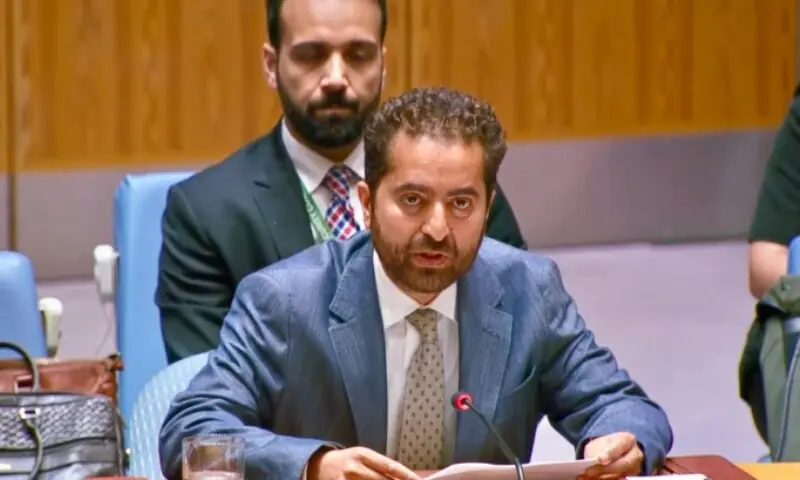
Pakistan on Thursday rejected India’s attempt to “distort facts” regarding the Indus Water Treaty (IWT) during a United Nations Security Council (UNSC) open debate, describing New Delhi’s actions following the attack in occupied Kashmir’s Pulwama as “simply illegal.”
Speaking at the UNSC debate on natural resource governance, Pakistan’s Permanent Representative to the UN, Asim Iftikhar Ahmad, criticised India’s unilateral decision to place the treaty in abeyance. He stressed that “no state should be permitted to abuse shared water resources as an instrument of coercion or political pressure, much less when it breaches solemn treaty obligations.”
In response, India’s Permanent Representative to the UN, Ambassador Harish Parvathaneni, accused Pakistan of “state-sponsored cross-border terrorism,” arguing that such actions had “eroded the basis for bilateral cooperation on the treaty,” according to Indian news agency ANI. He also reiterated New Delhi’s claim over occupied Kashmir.
Replying to these remarks, Pakistan’s First Secretary, Ansar Shah, dismissed India’s “misleading statement” as a “futile attempt to distort facts and misrepresent the situation.”
He emphasised that the Indus Water Treaty contains no provision allowing it to be placed in abeyance. “The treaty contains no provision whatsoever permitting its so-called abeyance. India’s unilateral action is simply illegal,” he stated.
Shah further pointed out that the Permanent Court of Arbitration (PCA), in its August 2025 award, reaffirmed that the treaty “remains valid, binding and fully in force,” including its dispute settlement mechanisms.
He argued that India’s weaponisation of a shared natural resource for political coercion, with the stated objective of depriving Pakistan’s population of water, constitutes a serious violation of international law and legal obligations. According to Shah, this situation represents a direct threat to regional and international peace and security and is highly relevant to the UNSC debate.
Addressing India’s allegations of terrorism, Shah rejected them as baseless and claimed they were intended to divert attention from India’s own involvement in sponsoring terrorism against Pakistan.
He stated that India’s alleged terrorist proxies—including the Tehreek-i-Taliban Pakistan (TTP), Balochistan Liberation Army (BLA), and Majeed Brigade—have been responsible for the deaths of thousands of Pakistani civilians and law enforcement personnel, including women and children.
Shah also alleged India’s involvement in extraterritorial killings, including incidents in North America, and asserted that “India is not a victim of terrorism. It is a sponsor of terrorism.”
He further accused India of carrying out state terrorism in occupied Kashmir, stating that the people of the territory continue to be denied their right to self-determination in violation of numerous UN Security Council resolutions.
According to Shah, India has consistently failed to fulfil its obligations under the UN Charter, particularly Article 25, which requires member states to implement Security Council decisions. He maintained that occupied Kashmir “never was, nor is, an integral part of India.”
He concluded by saying that no unilateral or unlawful measures taken by the occupying power can alter the historical, legal, or disputed status of the occupied territory of Jammu and Kashmir.
Natural resource governance must be based on international law
Earlier in the debate, Ambassador Asim Iftikhar Ahmad stressed that natural resources should promote sustainable development and shared prosperity rather than become sources of conflict, coercion, or exploitation.
He observed that weak governance, illegal resource extraction, external interference, violations of international law and the UN Charter, and the unequal distribution of natural resource benefits continue to fuel instability, conflict, and humanitarian crises around the world.
Referring to Africa, Ahmad noted that Pakistan has consistently supported African countries in their efforts to exercise sovereign control over their natural resources.
He emphasised that sustainable peace cannot exist where abundant natural wealth is accompanied by widespread poverty and underdevelopment, describing such a situation as “a recipe for conflict.” He added that natural resource governance must remain firmly rooted in the UN Charter and international law.
Ahmad reaffirmed that the right of peoples to permanent sovereignty over their natural wealth and resources, as recognised in UN General Assembly Resolution 1803, is a fundamental principle. He stressed that international cooperation should strengthen national capacities while respecting each country’s ownership, priorities, and policy space.
Turning to the Indus Water Treaty, Ahmad criticised India’s decision to place the agreement in abeyance.
“Our eastern neighbour has sought to weaponize water against Pakistan by abusing its status as the upper riparian, unilaterally and illegally placing the Indus Waters Treaty in abeyance – a course of action for which neither the Treaty, nor the general principles of international law, provide any basis whatsoever. Pakistan categorically rejects this unlawful action, which directly threatens the livelihoods and well-being of more than 240 million people of Pakistan,” he said.
He reiterated that the Indus Water Treaty remains “valid, binding and fully in force,” as confirmed by the Court of Arbitration’s August 2025 award.
Ahmad further stated that no country should be allowed to use shared water resources as a political tool or instrument of coercion, particularly in violation of binding treaty obligations. He warned that such actions, especially against the backdrop of the longstanding Jammu and Kashmir dispute, pose serious risks to regional and international peace and security.
Concluding his remarks, Ahmad said that the UN Security Council has an important responsibility whenever the exploitation or weaponisation of natural resources threatens international peace and security. This includes situations involving the illegal exploitation of minerals that fuel conflict, as well as unilateral actions that misuse shared natural resources in violation of international law and treaty commitments.
He urged the Security Council to remain vigilant and to make full use of available mechanisms—including preventive diplomacy, peaceful dispute resolution, sanctions regimes, and monitoring mechanisms—to address such threats.
Leave a Reply