
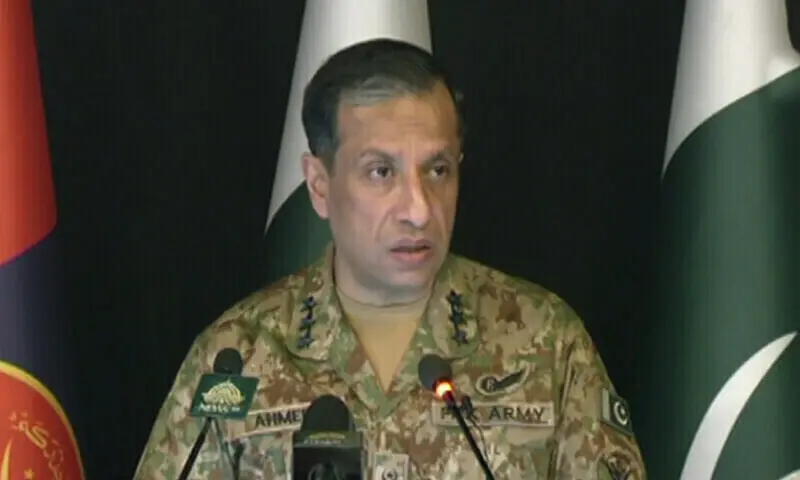
Inter-Services Public Relations (ISPR) Director General Lieutenant General Ahmed Sharif Chaudhry has said that the Makkah Defence Alliance — a tripartite agreement between Pakistan, Saudi Arabia and Turkiye — has no “regional aspirations”, adding that it is intended for collective deterrence.
The military spokesperson made the remarks during an interview on Al Arabiya English’s programme ‘Global News Today’, during a conversation with the host, Tom Burges Watson.
During the show, aired during the early hours of Wednesday, Lt Gen Chaudhry was asked about Pakistan’s commitments under the agreement.
“It formalises Pakistan’s decades-old relationship with the kingdom of Saudi Arabia and the brotherly country of Turkiye in the domains of collective deterrence and defence,” he said.
Watson then asked whether the pact was primarily a defensive cooperation or the beginning of a broader strategic alliance. To that, Lt Gen Chaudhry asserted that the pact was defensive, as its name implied.
“It is defensive. There’s nothing aggressive. There are no regional aspirations. It is collective deterrence,” he said, adding that the agreement was also “complementary”.
Elaborating further, he said the countries part of the alliance had independent relationships with other nations, blocs and alliances.
“So this mutual defence agreement is complementary in nature. It is not competing with any other relationship of these countries,” he added.
At that, Watson asked, “But does it contain any mutual defence obligation?”
In his short reply to the question, Lt Gen Chaudhry remarked, “The text that has been made public by the leadership of the three countries enunciates that very clearly and it’s interpretation is quite clear.”
Asked how Pakistan would respond if one of the countries in the alliance came under attack, he said that the operationalisation of defensive commitments was never made public in any discourse.
“You see, you have multiple other agreements which are defensive in nature, which are committal in nature. But no country comes out and starts sharing its operational details […] What you’re asking is the how part — that how we are going to defend Pakistan against any aggression.
“That is always part of the operational classification and security […] What you’re asking is that how it will be done. It is for the three countries to decide, and it is for them to know and for them to actualise it,” he said.
Specifically asked whether the military spokesperson saw the alliance “complementing or competing” with Pakistan’s relationship with China, Lt Gen Chaudhry asserted that it complemented Islamabad-Beijing ties.
“We need to understand that the Pak-Saudi and the Pak-Turkiye relationship has not come out of the blue. The Chinese understand it. The world at large understands it. That’s how historic these relationships are. We have formalised that.
“Nobody has any problem with that. Everyone understands that this is defensive. Everyone understands it is for maintaining stability and peace in the region. And all the three countries that are part of it, they have a wonderful relationship with China,” he said.
During the interview, Lt Gen Chaudhry was also asked whether he saw the defence agreement becoming a part of the wider, Muslim-world security architecture.
He replied that there was nothing in the pact that stated that it was a Muslim alliance, adding that it was an alliance for regional stability.
“It is not a club that is being made for only Muslim countries,” he said, adding that decisions on its expansion were to be taken by the leadership of Pakistan, Saudi Arabia and Turkiye.
“This agreement, this alliance can always encompass new, willing partners who also believe in regional peace, stability and security, [and] who have a shared vision of non-aggression, non-interference and collective deterrence.
“But that’s for the leadership of these three countries to decide; the how and when part,” he elaborated.
The joint defence pact was signed on Aug 7 and provides that an attack on one member state would be treated as an attack on all. Its inaugural meeting was held in Istanbul on Aug 31, where it was decided that Pakistan would initially head the alliance’s secretariat for three years.
Since its signing, there has been conversation about the possibility of its expansion, with Turkiye initially suggesting the possibility of Egypt’s inclusion. Though there has been no confirmation from Cairo.
From Pakistan, Prime Minister Shehbaz Sharif and Deputy Prime Minister and Foreign Minister Ishaq Dar clarified soon after the signing that the pact was defensive in nature, with the latter saying that it was also “open to any country in the region” willing to uphold its fundamental principles.
However, when Foreign Office spokesperson Sajjah Haider Khan was asked about possibility of the pact’s expansion during a weekly media briefing last week, he said an expansion was not on the cards at that point.
The three countries first needed to solidify the new organisation before considering opening it to other states with similar threat perceptions and requirements, he explained.
US-Iran mediation and Pakistan’s ‘unique position’
During the interview, Lt Gen Chaudhry was also asked about Pakistan’s efforts to mediate between the United States and Iran and whether the Makkah Defence Alliance complicated Islamabad’s position towards Tehran.
Lt Gen Chaudhry replied such was not the case, adding that the alliance was based on decades-old strategic ties.
“This alliance is a formalisation of that strategic relationship in a peculiar environment,” he said, reiterating that the pact was based on collective deterrence. The defence pact, he said, had no offensive or aggressive element and was purely defensive in nature.
Asked why Pakistan had opted to play the role of a mediator in the ongoing Middle East conflict that began with US-Israeli strikes on Iran in February, he succinctly stated, “For regional peace.”
Lt Gen Chaudhry then added that stability stemmed from peace and Pakistan was a proponent of peace in the region. Moreover, he continued, Pakistan had a “unique position” in this case because of its policy of alignment and engagement with countries across the world.
Hence, it could play the role of an “objective arbiter of peace and an honest broker of peace”.
To a question about progress on the mediation front and towards a settlement, Lt Gen Chaudhry explained that one of the prerequisites of good mediation was remaining objective and neutral.
“So it’s not for us as a mediator to start commenting on things that are happening or that are bound to happen,” he said, adding that Pakistan’s political and military leadership had been reaching out to all the parties so that “better sense prevails and, instead of a military solution, we come to a negotiated outcome of this very complex situation”.
Watson then pointed to the possibility of the US and Iran rejecting Pakistan’s proposal and asked whether Islamabad was prepared to continue its mediation in that case.
Lt Gen Chaudhry replied, “Is there any other way of resolving this conflict other than [through] mediation? Is there any other desirable way of doing that?”
He stressed the need for a “negotiated, peaceful outcome”, adding that those who could mediate objectively and sincerely between the two sides must continue their efforts.
Asked whether Pakistan was concerned about the conflict spilling over towards its western frontiers, Lt Gen Chaudhry answered that as far as Pakistan’s borders, territorial integrity and sovereignty were concerned, “we are very confident and very self-reliant on our security”.
There were always concerns of any conflict spiralling horizontally or vertically, he said, adding that not just Pakistan, but the entire world at large was feeling the impact of the conflict.
“So, there are [always] concerns in multiple domains”, but Pakistan was “fully confident of taking care of whatever nefarious designs come out of that towards” it, he said.
Asked whether Pakistan aimed to become a regional mediator or was simply trying to prevent a regional war from reaching its own doorstep, Lt Gen Chaudhry said, “Pakistan is interested in regional peace and stability, because peace and stability are essential for development, for human development, for prosperity and for the citizens of Pakistan and the region.”
And if the “mediation is for peace, […] and we’ll always be there”.
Prospects of dialogue with India
Watson then came to the brief military conflict between Pakistan and India in May last year, and asked what lessons Pakistan’s military had learned from the episode.
Lt Gen Chaudhry replied that what was more important were the lessons Pakistan and its military taught during that conflict. He said that a military conflict between two nuclear countries, especially neighbours, was “out of question”.
“It’s a sheer, I would say, a sort of mad idea,” he said, adding that Pakistan also showed that India made a “strategic folly” in May last year.
Asked whether he believed India had learned that lesson, Lt Gen Chaudhry replied it was for the Indian side to answer.
“Our job in Pakistan is to keep on reminding them of that lesson,” he said, adding that the other side had a “hubristic mindset” and the Indian military was “deeply politicised”.
In India, he continued, there was a propensity of externalising their internal problems, giving the example of minorities facing oppression.
On the other hand, he said, there was the Kashmir issue, which was an “external problem” that New Delhi wanted to “internalise through repression”.
The military’s spokesperson added that Pakistan continued to give out the message to India that it believed in “peace on equal terms” and that it was a rational and objective player.
Pakistan believes in regional peace, but if India has any “misconceptions about [imposing] regional hegemony through military aggression, results of that would be beyond their imagination”, he warned.
Lt Gen Chaudhry said Pakistan had showed India and the world in May last year that it had the capability and resolve to dominate and control an escalation.
“And we’ll do it again,” he added.
Asked whether there were any realistic prospects of restoring sustained military-to-military communication with India, Lt Gen Chaudhry said, “Yes, of course.”
He added that communication between the directors general of military operations had remained effective during the May conflict and beyond.
“Communication is always good. We must communicate, we must engage, but that engagement has to be done on equal terms while respecting each other’s integrity and sovereignty,” he said.
To a question about resuming dialogue with India, he said it was for the political leadership to decide. But dialogue, he said, had to be on equal terms.
“Dialogue cannot be, or engagement cannot be to provide a cover for the ongoing state-sponsored Indian terrorism in Pakistan, for the ongoing aggression,” he emphasised.
‘Only successful counter-terrorism campaign in the world’
Coming to Afghanistan, Watson asked about the Pakistani military’s preferred end state with the Afghan Taliban.
“I think the military’s end state is actually part of Pakistan’s end state that the political leadership sets. So, there is no separate military end state.
“So, there are Pakistan’s objectives and desire, which are primarily the domain of the Pakistan’s political leadership and an expression of the will of the people of Pakistan. And what that is that we want — no interference, no terrorism from Afghanistan in Pakistan. So that’s the foundation,” he said.
Asked what options Pakistan considered legitimate for preventing cross-border attacks in case of the failure of diplomacy, Lt Gen Chaudhry said, “Right of self-defence is enshrined in the Article 51 of the United Nations; right of self-defence is given to each nation state of the world.”
He added that the Pakistani state had an obligation to defend the lives, honour and property of its citizens. To that end, “all that is necessary will be done and is being done”.
In this connection, he detailed Pakistan’s counter-terrorism measures and said the country’s counter-terrorism campaign was the “only successful counter-terrorism campaign in the world”.
“Because we are the bulwark state against” terrorism emanating from Afghanistan, he said.
Lt Gen Chaudhry also mentioned that in the current year, 42,000 intelligence-based operations (IBOs) had been carried out and 2,100 terrorists had been killed.
Towards the programme’s end, Watson steered the discussion towards Balochistan, on which Lt Gen Chaudhry said there was no insurgency in the province.
“There’s just terrorism,” he said, adding that the military had clarity on that, tactically and strategically.
He said of the 42,000 IBOs, over 32,000 were conducted in Balochistan and security forces remained engaged in “taking out the so-called proxies who associate themselves with Balochistan and have got nothing to do with it”.
Regarding strategic clarity, he said the government, people of Balochistan and the military understood that the way to deal with terrorism was to kill terrorists and “embrace the people of Balochistan”.
Leave a Reply