
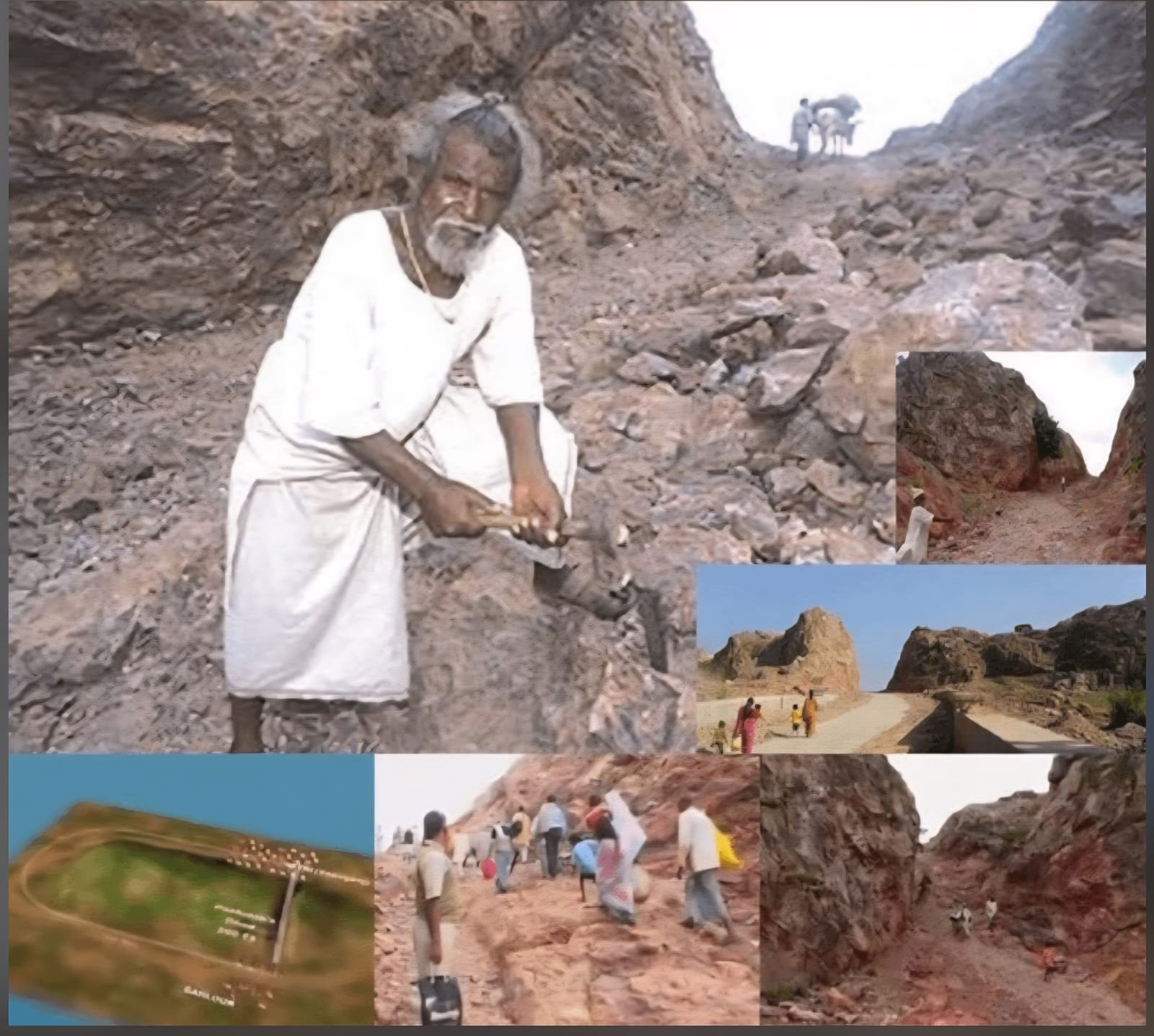

In the dry, sun-scorched expanse of Gehlaur village near Gaya, a towering ridge of solid quartzite, part of the rugged Rajgir Hills, stood like an unbreakable wall between life and death. While geologists call it a hill ridge, to the locals it was an imposing mountain of razor-sharp, ancient stone. For generations, this massive wall dictated terms to the people living under its shadow, completely severing them from hospitals, schools, and basic safety.
In 1959, that brutal wall of stone took Falguni Devi. Her only mistake was attempting to carry a simple meal up the narrow, treacherous ridge to her husband, Dashrath. One misplaced step on the loose cliffside sent her tumbling into the gorge below. Her injuries were severe, but it was time and the crushing 55-kilometer detour around the jagged ridge, that ultimately ended her life. She succumbed to her wounds long before medical aid could ever reach her.
Driven by grief that refused to settle into quiet acceptance, Dashrath Manjhi looked up at the towering cliff face. Quartzite is one of the hardest, most stubborn rock types on Earth, resistant to weathering and nearly impossible to shatter without heavy explosives. Yet Manjhi sold his family’s only asset, a few goats, to purchase an iron hammer, a chisel, and a crowbar, and stepped up to the base of the ridge to declare war on the rock.
Read More: Tragedy at PIMS: How 14 Newborn Lives Were Lost to Systemic Failure
When his hammer first struck stone, the village laughed. They called him a madman, a grieving soul wasting his remaining years fighting an ancient titan with iron hand tools. But every morning before dawn, and long into the night under the pale moon, the rhythm continued: clang, clang, clang. Through blistering summer heatwaves that made the metal tools scorch his skin, bitter winter frost, cracked callouses, and decades of silence, he kept swinging. As years bled into decades, the mockery turned into quiet respect. Neighbors began dropping off meals or gifting him fresh iron chisels as they watched the solid cliff slowly give way.
In 1982, after twenty-two years of solitary manual labor, the dust settled. Manjhi had moved thousands of tons of solid rock, carving a path 360 feet long, 30 feet wide, and 25 feet deep straight through the heart of the ridge. Single-handedly, using nothing but simple hand tools, he slashed a grueling 55-kilometer ordeal down to a mere 15-kilometer walk.
Yet Manjhi’s mission did not end at the rock.. Determined to bring real change to his neglected village, he walked over 500 kilometers along train tracks all the way to New Delhi to petition bureaucrats for a paved road, a hospital, and a primary school. Though officials brushed him off at first, his story eventually captured the entire nation’s conscience.
Years later, during a public gathering, Bihar’s Chief Minister Nitish Kumar stood up out of sheer respect and handed Manjhi his own executive chair. When the state government awarded Manjhi five acres of land as a reward for his monumental achievement, he refused to keep it for himself, instantly donating it back so the state could construct a local hospital.
When Dashrath Manjhi passed away in 2007, the government honored him with a full State Funeral. Authorities finally blacktopped the gap he had carved, officially naming the highway the Dashrath Manjhi Path, and fulfilled his lifelong dream by building the hospital, primary school, and electricity network for Gehlaur. In 2016, India Post even issued an official commemorative postage stamp in his memory.
He didn’t just carve a path through stone; he proved that while grief can shatter a man, love and unwavering purpose can force even a mountain of granite to bow.
Leave a Reply