
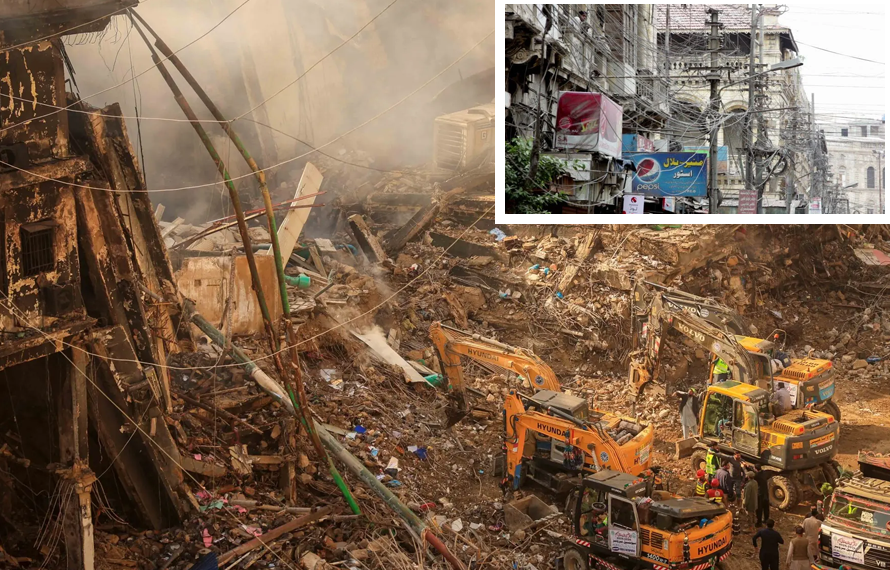

The tangled, chaotic, and dangerously exposed web of electricity wires across Karachi fills me with genuine fear. Passing through areas like Saddar, Tariq Road, Bolton Market, MA Jinnah Road, Liaquatabad, Nazimabad, North Karachi, and around Saddar Tower, it often feels as if the city is standing on the edge of a catastrophe. Wires hang loosely from walls, cables are knotted together without order, open meters spark silently, and temporary connections have been normalized for years. Everything about this picture screams danger. Yet one question keeps returning to my mind: does anyone truly notice this, or are we collectively waiting for a tragedy to force our attention?
The fire at Gul Plaza brought this question back with brutal clarity—this time wrapped in smoke, screams, and ashes.
Gul Plaza was not an abandoned or insignificant building. It was one of Karachi’s busiest commercial centers, a functioning marketplace that welcomed hundreds of shopkeepers, employees, and customers every day. It was part of the city’s economic pulse. And yet, safety within its walls was almost nonexistent. The fire broke out at night, and initial reports pointed to an electrical short circuit. But the truth is that a short circuit is never the real cause. It is only the final spark. The real fire had been burning for years in the form of negligence, poor planning, and a deeply irresponsible attitude toward safety.
Read More: Virginia Makes History as Ghazala Hashmi Sworn In as Lieutenant Governor
When the flames spread through Gul Plaza, the situation spiraled out of control within minutes. Escape routes were limited. Most exits were closed. Staircases filled rapidly with thick smoke, and windows reinforced with iron grills turned into cages. That moment exposed a failure far larger than a single building. It was the collapse of an entire system. Had emergency exits been accessible, had fire alarms sounded in time, had an automatic fire suppression system been installed, this tragedy might not have reached such devastating proportions. But in the end, there was nothing left except “if only” and “what if.”
The real question is not why the fire started. The real question is why it was allowed to become so deadly. The answer lies in Karachi’s broader urban reality. This city has expanded without effective planning, construction has continued with little respect for regulations, and safety has consistently been treated as an unnecessary expense rather than a basic responsibility. Buildings are designed to maximize shops, floors, and profits, but rarely to protect human lives. Fire safety exists in files and paperwork—not in real structures.
After the Gul Plaza tragedy, the Sindh government announced deadlines for commercial buildings to update their fire safety systems. Audits were promised, strict action was declared, and sealing of non-compliant buildings was discussed. These steps may be necessary, but they raise a far more uncomfortable question: why could this not have been done earlier? The core responsibility of any administration is to organize systems before damage occurs, to identify risks before disasters strike, and to ensure preparedness before lives are lost. If deadlines can be issued today, why were they absent yesterday? If laws can suddenly be enforced now, why was there silence before Gul Plaza burned?
It is also important to recognize that Gul Plaza is not an isolated case. Commercial buildings on Tariq Road, aging structures in Saddar, the narrow lanes of Bolton Market, and crowded markets in Liaquatabad and Nazimabad all carry the same risks. Electrical systems are overloaded, access routes are dangerously narrow, fire brigade entry is difficult, and safety regulations exist only on paper. Seeing this reality makes one wonder whether we truly wake up only after devastation has already occurred.
It is easy to place the entire burden of responsibility on the government or regulatory authorities, but the truth is far more uncomfortable. Building owners, market administrations, shopkeepers, and we as citizens have all looked away at one point or another. We did not ask why emergency exits were locked. We did not demand functional fire safety systems. We did not protest when our lives were treated as expendable. Our silence empowered the negligence that ultimately led to tragedies like Gul Plaza.
After every major incident, the pattern repeats itself. Inquiries are announced, promises are made, the media raises its voice for a few days, and then everything returns to normal. Buildings remain unchanged, wires continue to hang dangerously, and the threat quietly waits for its next opportunity. Gul Plaza burned down, but the real question remains unanswered: did we actually learn anything?
The real problem is not fire. The real problem is our mindset. A mindset that ignores visible danger. A mindset that understands the value of human life only after irreversible loss. A mindset that views safety regulations as obstacles and precautionary measures as unnecessary costs. Until this mindset changes, until laws move from paper into practice, and until prevention replaces reaction, tragedies like this will continue to repeat themselves.
The fire at Gul Plaza did not only reduce a building to ashes. It exposed the cracks in our entire system. Even now, there is still time to ask ourselves—honestly and without excuses: are we truly waiting for the next disaster, or do we finally have the courage to change before it arrives?
Leave a Reply