
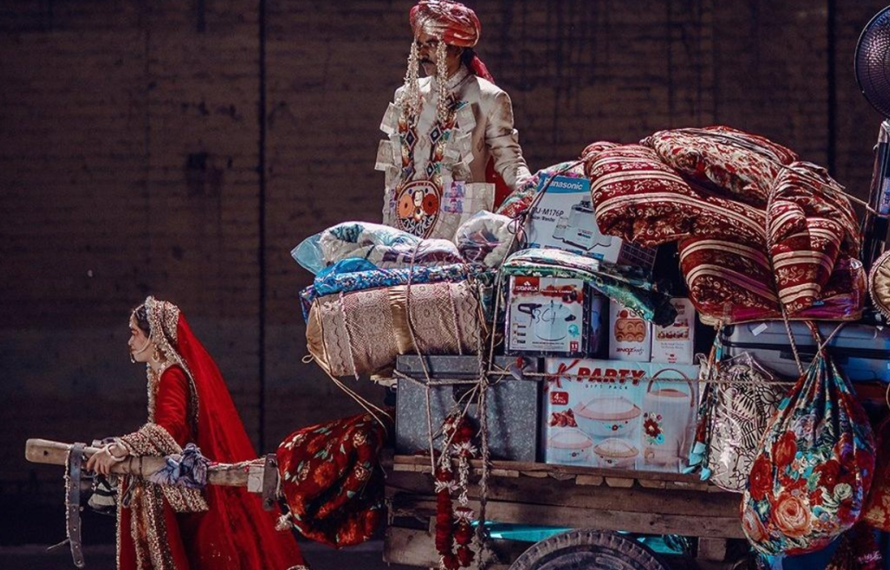

Muhammad Aslam, a father of five daughters, was preparing for what should have been the happiest day of his eldest daughter Ayesha’s life. Wedding arrangements were almost complete, and relatives had gathered at his modest home, sharing excitement and anticipation. The house was alive with chatter, prayers, and the quiet hope that Ayesha’s future would be secure. But just as the ceremony was about to begin, a storm arrived.
The groom’s mother and sisters approached Muhammad Aslam with a cold, calculated demand. They insisted on a brand-new car and handed him an intimidating list of furniture, electronics, and countless other items, all presented under the name of ‘Jahez‘. Their message was clear and merciless: “We will return the baraat.” In an instant, the joy of the day was replaced by a familiar Pakistani nightmare.
As relatives gathered, pressure mounted. Some advised Aslam to give in, reminding him of his four other daughters and the social disgrace of a cancelled wedding. Others whispered that this greed was a warning of a miserable future.
Ayesha, dressed as a bride, listened in silence as a battle raged in her mind between fear, dignity, and love for her father. Finally, She made a decision that few dare to make.. She stood up and spoke loudly: “No. I will not sacrifice myself for this rotten tradition. I will stand beside my father. I refuse this marriage. Take your baraat back.” She removed her bangles, placed them in the hands of the groom’s sister, and said, “These would be better worn by your brother instead.”
The room fell silent. While some scolded her for being “Bold,” a powerful truth had been revealed.
This is not an isolated incident. Across Pakistan, the dowry system has evolved from a voluntary gift into a rigid social demand that dictates the safety, dignity, and survival of women. Parents routinely spend beyond their means, selling property or taking lifelong loans to meet these expectations. Families like Muhammad Aslam’s are trapped in the “patriarchal belt” of South Asia, alongside India, Bangladesh, and Nepal, where social norms are manipulated to favor men and entrench unequal power structures.
Despite being a widespread practice, jahez is frequently disguised as an essential cultural tradition, allowing exploitation to continue unchecked under the veil of custom. While modern society speaks of progress and human dignity, reality remains out of reach for many. Low literacy, poverty, and the fear of social isolation make it nearly impossible for women to escape these situations. For those trapped in abusive environments, the support systems they need feel distant and unresponsive, overshadowed by the immense pressure to maintain family “honor” at any cost.
The depth of this crisis is often ignored by the mainstream media. A study conducted in 2002, analyzing 30 days of Pakistani newspaper coverage, revealed that out of 206 reports on violence against women, only 23 reflected any aspect of dowry. This alarming gap shows how dowry-related violence is minimized as a “private” family issue. Yet the impact is devastating: fathers are financially ruined, brothers carry debt for decades, and entire families suffer emotional and economic trauma.
Violence is not just financial; it is lethal. A pioneering 2009 study titled “Forgotten Dowry: A Socially Endorsed Form of Violence in Pakistan” revealed that thousands of “bride-burning” cases have occurred. These are often carefully engineered “kitchen accidents,” where stoves are tampered with to disguise murder as suicide. An Amnesty International report from 1999 documented 1,600 such cases. Of these, only sixty were prosecuted, and a shocking two resulted in convictions.
Several deep-rooted factors ensure the continuation of this social curse. For many families, dowry is viewed as an essential incentive to secure a “better” match or as a necessary act of submission to the demands of a socially desirable groom. More insidiously, it is frequently used as an excuse to deny women their rightful inheritance, where wedding expenses are falsely portrayed as a form of “compensation” for their share of family assets. While dowry is often publicly justified as support for the new couple, it has become a socially enforced practice that families follow with a smile, despite the immense pain and financial ruin it causes behind closed doors.
Pakistan provides a legal framework through the Dowry and Bridal Gift (Restriction) Act of 1976, which was established to set an upper limit on wedding expenses. While this law exists to guide social conduct, in many cases the pressures of tradition lead families to prioritize cultural expectations over legal limits. Over time, the Pakistan Law Commission has reviewed these guidelines to better reflect modern economic realities. However, the true challenge remains the social mindset, where dowry continues to be viewed as a symbol of status, often independent of formal legal standards.
Muhammad Aslam’s story exposes a painful reality: dowry is not a harmless tradition. It is a financial trap, a threat to safety, and a moral failure. Ayesha’s refusal was a rare act of courage, but until this practice is confronted honestly and the legal system begins to hold perpetrators accountable, thousands of families will continue to pay the price for a curse that society refuses to break.
Leave a Reply