
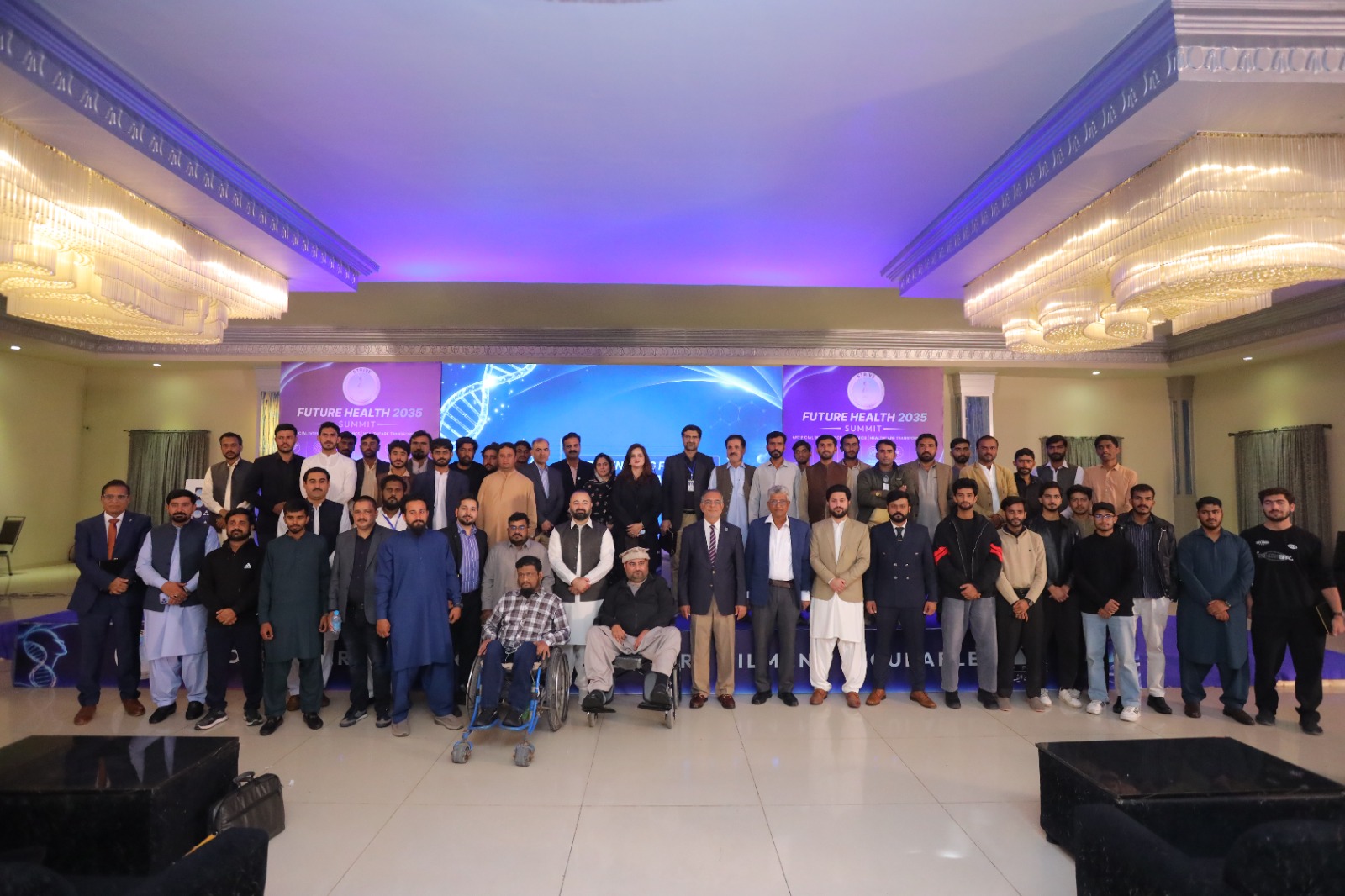
ISLAMABAD – The growing role of genetic science in identifying and understanding inherited disorders was a key focus of a one-day summit held on Friday that highlighted the need to improve genetic screening, diagnosis and healthcare services in Pakistan.
The event brought together specialists from different medical and scientific fields, who shared their expertise on inherited disorders, genetic diagnosis and emerging developments in genomic science.
Organized by the Strive Eradication of Disability Foundation in collaboration with the Pakistan Poverty Alleviation Fund, the summit – Future Health 2035 – featured a conference and an expo showcasing advances in healthcare.
The panelists regretted that in cases of genetic and rare diseases, families mostly rely only on family support due to the absence of any national body.
Dr. Salman Kirmani, Medical Geneticist, Aga Khan University Hospital, Karachi, said it was unfortunate that there is no national or community-level support for parents of children with Spinal Muscular Atrophy (SMA), as Pakistan lacks a national-level genetic institute like the rare genetic organisations working internationally. He noted that the government spends heavily on polio but not on diseases like SMA. Polio has now become a rare disease, while SMA is more common than polio.
He said rare diseases are not rare in Pakistan due to the large population and cousin marriages.
Dr. Fizza Akbar, Genetic Counsellor, Agha Khan University Hospital, Karachi, said 60 percent of our population is married within families and the ratio is highest among the Muslim countries.
Dr. Fizza said there is a 25 percent chance of a child inheriting a genetic disorder if both parents are carriers. She said the disease can be diagnosed early and managed with medications, but its transmission cannot be stopped, nor can it be cured before or during conception.
Dr. Kirmani said a prenatal test can diagnose the condition within 120 days of pregnancy, and if the test is positive, the pregnancy can be terminated. He said there is a decree of Jamia Al Azhar and ulema has a consensus on it that the pregnancy can be terminated in such life threatening diseases.
Dr. Jawad Hassan , Molecular Geneticist, Shifa International Hospital said with a genetic disease often comes a disability and people with genetic diseases need specialized and multidisciplinary care but it is not available in Pakistan except in a few tertiary care hospitals.
Dr. Isaac John, who has 40 years of international experience in health, said that in Europe, education and health are fundamental rights, but here, due to budgetary constraints, we have not been able to deal with major infectious diseases, and thus the challenges are huge.
Dr. Farhan Ali, Consultant Pediatric Neurologist, Frontier Corps Teaching Hospital, Peshawar, said cases of SMA are becoming quite common these days. He said earlier he used to see 1 to 2 patients in a month, but now he sees 3 to 4 patients in a month. He added that many cases go unnoticed due to lack of diagnosis. He shared that a woman came to him saying her 3 children had died of pneumonia, but after inquiry, it turned out they were patients of SMA.
Haris Tariq, parent of a 4-year-old SMA child, said it is difficult to ask for donations due to lack of awareness in society. People do not understand the severity of the disease, its lifelong consequences, and the cost of its expensive treatment. “They often mock families, thinking that despite coming from middle-income backgrounds, they are asking for donations, with little knowledge that even a few doses of medicine cost millions, and that treatment is a lifelong cycle”.
Strive CEO Yasir Khan said it’s unfortunate that genetic tests are quite expensive that 99 per ent of the population can’t afford it.
He asserted that it’s the people’s right to get healthcare services even if the diseases are rare.
He said people should ask for their rights. When Strive being a small organisation supporting children why can’t a government with unlimited resources. He appreciated the previous Khyber Pakhtunkhwa government that was willing to arrange healthcare services for it’s people.
Both SMA and DMD are rare, inherited and progressive neuromuscular disorders that cause muscle weakness and affect mobility. However, they have different genetic causes and affect the body in different ways.
Leave a Reply