
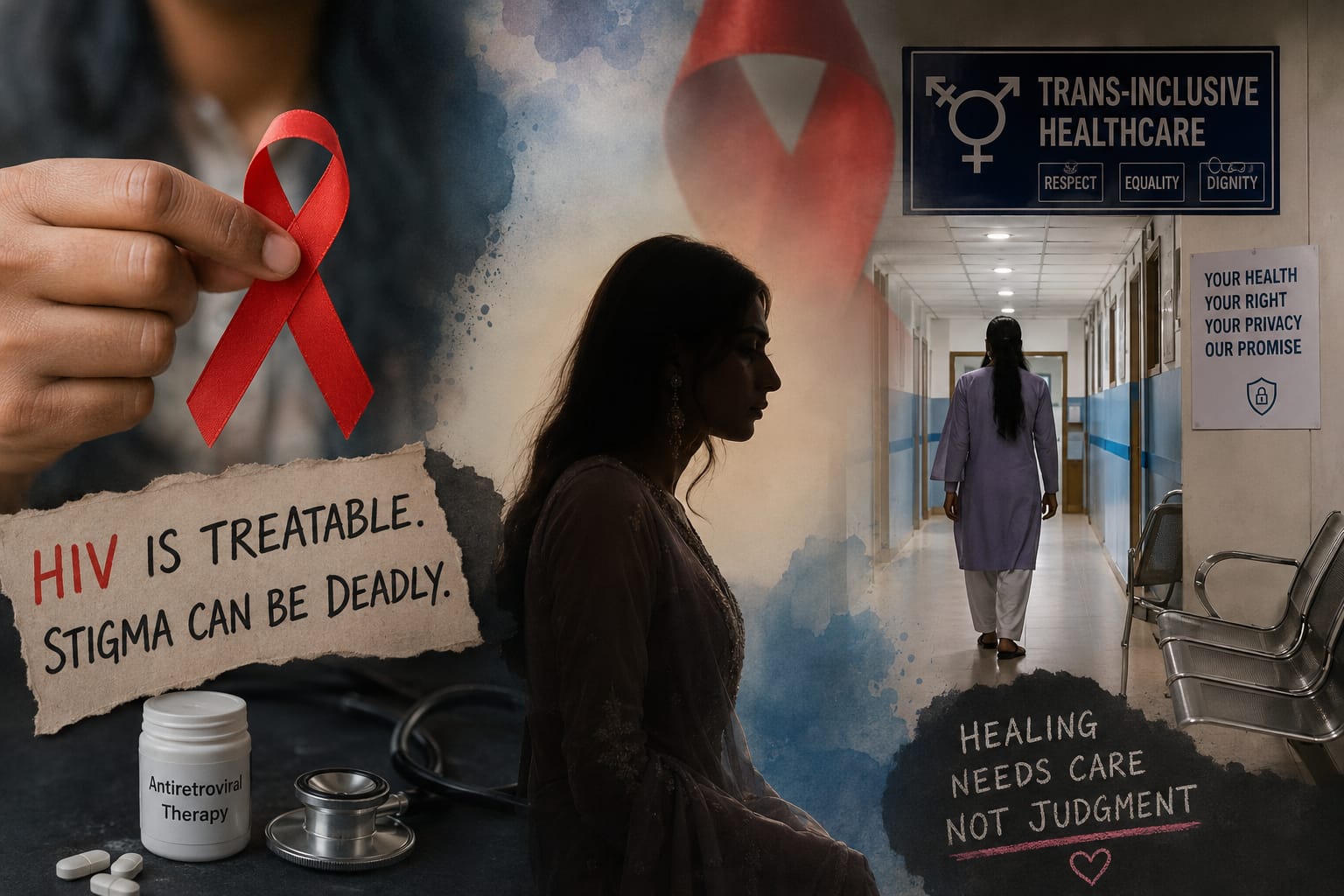
When sonia (not her real name), a 22-year-old transgender woman in Khyber Pakhtunkhwa, learned that she was living with HIV, she did not immediately seek treatment. It was not simply a question of whether medicines or healthcare services were available. She was afraid of what might happen if people around her discovered her HIV status. Sonia earned her living by performing at weddings and social gatherings, and her livelihood depended heavily on the surrounding community. According to accounts reported in August 2025, she feared losing that livelihood and the social support on which she depended. She concealed her diagnosis while her health deteriorated. By the time she was taken to Lady Reading Hospital in Peshawar, she was critically ill and later died after suffering severe complications.
Sonia’s story raises an uncomfortable question about Pakistan’s HIV response. What does it mean for treatment to be available if fear, stigma and social exclusion prevent someone from accessing it in time? HIV is treatable, and antiretroviral therapy enables people living with HIV to live long and healthy lives when diagnosis, treatment and continuity of care are ensured. Yet medicines can only work when people feel able to seek testing, enter treatment and remain connected to healthcare. Sonia’s story should therefore not be read simply as an individual tragedy. It illustrates the potentially life-threatening consequences that can arise when a manageable medical condition collides with fear of rejection.
This distinction between the availability and accessibility of healthcare is particularly important in Khyber Pakhtunkhwa. By June 2025, the provincial HIV/AIDS programme had registered 8,398 people living with HIV, including 197 transgender people. Another 741 people were registered during the first six months of 2025. The province also had 13 antiretroviral therapy centres providing treatment and medicines to registered patients. These figures show that an HIV treatment infrastructure exists. But counting facilities tells us where services are located; it does not necessarily tell us whether the people who need those services feel able to use them.
For transgender people, accessibility can be shaped by circumstances far beyond the clinic itself. Many experience unstable employment, family rejection, poverty and dependence on informal community support. An HIV diagnosis can therefore create fears extending well beyond health: Will my family find out? Will I lose my income? Will I be asked to leave the place where I live? Will my medical information remain confidential? For someone whose housing, livelihood and social support are already fragile, disclosure can appear to threaten the foundations of everyday survival. In such circumstances, concealing illness may appear safer in the short term, even when delaying treatment creates much greater health risks.
Research by Blue Veins and the National Commission for Human Rights has described transgender people living with HIV in the province as confronting a “dual crisis”: the medical consequences associated with HIV alongside the social consequences of stigma. The research documented experiences involving family rejection, employment discrimination and barriers to healthcare. This distinction matters because HIV programmes cannot achieve their objectives through medicines alone. If social conditions make people afraid to test, disclose their status to healthcare professionals or continue treatment, those conditions become part of the public-health challenge.
The gap between formal entitlement and actual use can also be seen in the wider healthcare system. In February 2026, Dawn reported that only 15 transgender people had used Sehat Card Plus for free healthcare during the preceding year despite being eligible for the programme. The figure is not a measure of HIV treatment utilisation, but it raises a broader question about whether formal inclusion in healthcare schemes translates into meaningful access for transgender citizens. Community representatives attributed the low utilisation partly to fear of stigma and violence in healthcare settings. A service can therefore be free, geographically available and officially open to everyone while still remaining psychologically or socially inaccessible to those who fear using it.
The provincial government has recognised some of these concerns. In October 2025, the Health Department directed hospitals to provide dedicated wards, toilets and other facilities for transgender patients following complaints involving violence, admission difficulties and delays in treatment. Such measures are important because they acknowledge that equal healthcare sometimes requires institutions to identify and remove barriers experienced by particular communities. The more difficult question, however, is implementation. A notification can change administrative policy, but confidence in healthcare is ultimately built through what happens when a patient reaches the reception desk, speaks to a nurse, enters the consultation room and entrusts personal information to a healthcare professional.
For people living with HIV, confidentiality is central to that trust. A patient who believes their HIV status may become known to relatives, employers, neighbours or community members may decide that avoiding a healthcare facility is safer than risking disclosure. For transgender people who may already have limited family support or insecure livelihoods, those fears can be especially serious. Confidentiality must therefore be more than a professional principle written in guidelines. Patients need to know that their information will be protected in practice and that seeking HIV treatment will not expose them to humiliation, gossip or unnecessary disclosure.
Closing this gap requires more than campaigns telling transgender people to get tested or take their medicines. Healthcare workers need practical understanding of HIV, confidentiality and transgender-inclusive care. Facilities need clear and enforceable procedures for preventing discrimination and responding to complaints. Transgender-led organisations and peer networks can help connect people with services, particularly those who are reluctant to approach formal institutions. Most importantly, transgender people living with HIV should have a meaningful role in designing, monitoring and evaluating programmes intended to serve them. Their experiences can reveal barriers that administrative statistics alone cannot capture.
The language of HIV programmes also matters. Transgender people should not be reduced to labels suggesting that risk is inherent in their identity. HIV vulnerability is shaped by social and structural conditions, including poverty, discrimination, insecure employment, limited family support, violence and barriers to healthcare. Recognising these conditions does not diminish personal responsibility for health; it makes public-health interventions more realistic by addressing the environment in which health decisions are actually made.
Sonia’s story ultimately reminds us that the success of an HIV response cannot be measured only by the number of treatment centres established or medicines available. We must also ask whether the person who needs those services feels safe enough to use them before becoming seriously ill. Healthcare is truly accessible only when people can seek testing without fear, receive treatment without humiliation and trust that their identity and medical information will be respected.
HIV is treatable. But treatment that people are too frightened to reach cannot fulfil its purpose. For transgender people living with HIV, closing the distance between available healthcare and accessible healthcare may begin with something medicine alone cannot provide: trust. A healthcare system that creates that trust is not offering a special favour to transgender people. It is simply doing what healthcare is supposed to do.
Leave a Reply