
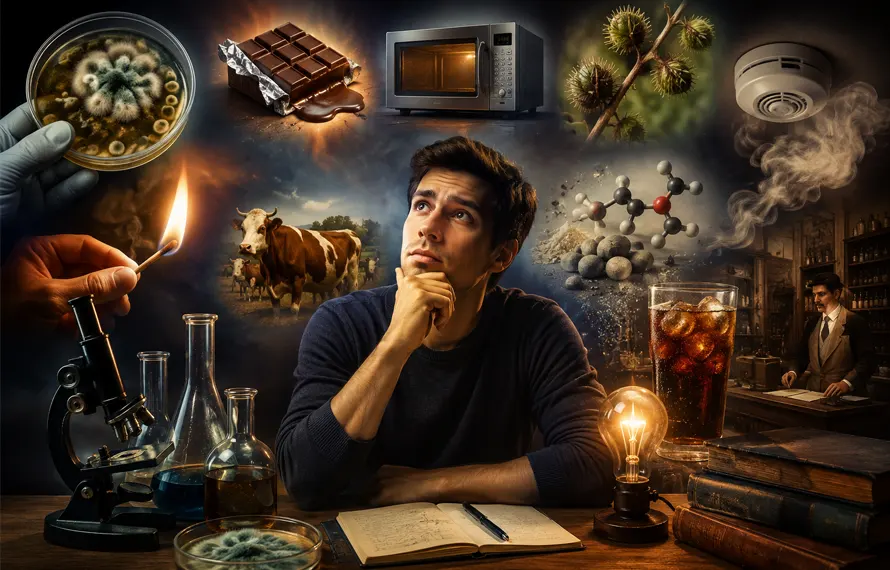

The more I read about famous inventions, the more fascinating this question becomes.Because some of the world’s most useful inventions did not begin with a perfect plan.They began with something unexpected.
A laboratory experiment went wrong. A chocolate bar melted. A few stubborn seeds got stuck to someone’s clothes. A chemical mixture suddenly caught fire.
And instead of walking away, someone looked at that strange little moment and thought, There may be something here.
That is what makes these stories so much fun to explore.
1. A Dirty Laboratory Dish and the Beginning of Penicillin
Let’s go back to Alexander Fleming’s laboratory in 1928.Fleming was studying bacteria when he noticed that one of his culture dishes had been contaminated with mold.
It looked like an experiment that had gone bad.
But then he noticed something unusual.
The bacteria were not growing around the mold. Fleming examined it more closely and investigated the substance produced by the mold. He named it penicillin.
That was only the beginning. Turning the discovery into a practical medicine required years of further work. Scientists including Howard Florey and Ernst Chain later helped develop ways to produce and use penicillin on a much larger scale.
Eventually, penicillin became one of the most important antibiotics in medical history. What could have ended as a dirty laboratory dish became the beginning of something that would save countless lives.
2. The Chocolate Bar That Helped Create the Microwave Oven
Now imagine being at work and reaching into your pocket for a chocolate bar, only to find that it has melted. That happened to American engineer Percy Spencer in 1945.
Spencer was working with magnetrons, equipment used in radar technology, when he noticed the melted chocolate. He became interested in the reason behind it.
Could the energy from the equipment be heating the chocolate?
He started testing the idea with other foods and found that microwave energy could produce heat. His experiments eventually contributed to the development of the microwave oven.
The first machines were huge compared with today’s kitchen microwaves. They were also expensive and far from convenient. But the basic principle was there.
Today, we put a plate inside, press a button and carry on with our day. It is hard to imagine that this everyday kitchen appliance has a story that began with a melted chocolate bar.
Read More: A Tale of Two Worlds: The True Cost of Modern Progress on the Roof of South Asia
3. Those Annoying Burrs That Became Velcro
George de Mestral probably did not expect a walk with his dog to inspire an invention. But in the 1940s, the Swiss engineer noticed that small burrs were clinging stubbornly to his clothes and his dog’s fur. Instead of simply pulling them off, he examined them under a microscope.
He found tiny hooks on the burrs. These hooks were catching onto loops in fabric and hair.
That gave him an idea.
Could this natural trick be copied?
He worked on the idea and eventually developed a fastening system made with tiny hooks and loops. It became known as Velcro.
I love this story because the inventor did not really create the idea from scratch. Nature had already worked it out. He simply noticed the clever little design hiding inside something most of us would find annoying.
4. A Failed Gas Detector That Found Something Else
In the 1930s, Swiss physicist Walter Jaeger was trying to develop a device that could detect poisonous gases. The experiment did not give him the result he wanted. But then the equipment reacted to smoke from his cigarette.
That unexpected reaction opened another possibility: perhaps the technology could be used to detect smoke. The work contributed to the development of smoke detection technology, which later became an important part of fire safety.
Today, a smoke alarm is such a familiar object that we hardly notice it hanging from the ceiling.
Yet its job is incredibly important. It can warn people about a fire before flames become obvious, giving them precious time to react.
A machine built to find one danger had pointed researchers toward another.
5. One Scrape, One Flame and the Friction Match
In the early 19th century, English pharmacist John Walker was experimenting with chemicals. During one experiment, a chemical mixture on the end of a stick caught fire when Walker scraped it against a rough surface. Instead of dismissing the reaction, Walker saw that it might have a practical use.
He developed the idea into an early friction match and began selling his matches in 1827.His invention made it much easier to produce a small flame whenever it was needed.
There is an interesting detail in this story. Walker did not patent his invention, so other manufacturers were able to copy and develop similar designs.
Today, striking a match is almost effortless.
One quick movement, one spark and there is fire. But that familiar little flame has a surprisingly unexpected history.
6. From Moldy Hay to Warfarin
This story begins with something going seriously wrong on farms. During the 1920s, farmers in North America began reporting unexplained bleeding and deaths among cattle. Scientists investigated and eventually linked the problem to moldy sweet-clover hay.
The mold produced substances that interfered with blood clotting.
Researchers continued studying these compounds, and at the University of Wisconsin, biochemist Karl Link and his team developed related compounds. One became known as warfarin.
At first, warfarin was used as a rodenticide. Later, researchers discovered that its effect on blood clotting could also be useful in medicine. It eventually became a drug used to help prevent dangerous blood clots.
It is an extraordinary journey.
Something that began with sick cattle and spoiled hay eventually became a medicine.
7. The Pharmacy Experiment That Became Coca-Cola
And now, perhaps the most delicious story on our list. In 1886, pharmacist John Pemberton was developing a new beverage in Atlanta. Medicinal and tonic drinks were popular at the time, and Pemberton was working on his own formula.
During the development process, the syrup was mixed with carbonated water. The result was a refreshing drink that was served at a pharmacy.
The first Coca-Cola was served at Jacobs’ Pharmacy in Atlanta on May 8, 1886.
Pemberton’s bookkeeper, Frank M. Robinson, suggested the name Coca-Cola and created the distinctive script used for the name. The drink’s first-year sales were very small. There was certainly no sign that it would become a worldwide brand.
But that modest beginning eventually turned into one of the most recognizable drinks on the planet.
Imagine walking into that pharmacy in 1886. A new drink is being served. Would anyone there have imagined its future?
Probably not.
Maybe the Real Invention Was the Way They Looked at Things!
After reading these stories, I keep coming back to the same thought. Maybe inventors are not people who always know what they are doing.
None of these things announced, “I am going to change the world.” Someone had to discover the possibility hidden inside them. And perhaps that is what separates an ordinary moment from an extraordinary one. The world gives us countless little surprises. And that small moment can become something much bigger than anyone expected.
Leave a Reply