
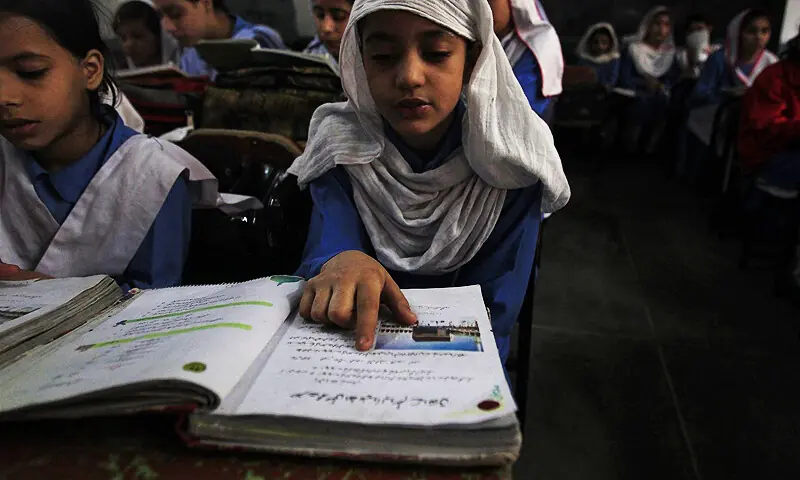
LAHORE: Punjab requires Rs135 billion to achieve 90pc literacy rate by 2035 as the province is grappling with the dual challenge of 9.6m out-of-school children (OOSC) and 26.8m adult illiterate population. The largest proportion of OOSC falls within the 8-16 years age group, which cannot be effectively absorbed by the formal education system, making the non-formal sector the only scalable and flexible platform to reach this overage population.
These shocking details are a part of the data received from the Literacy & Non-Formal Basic Education Department (LNFBED) on the International Literacy Day on Tuesday.
According to the LNFBED data, available with Dawn, adult literacy centres (ALCs) extend literacy services to 16+ populations through community-based, short-cycle interventions.
The department has established 20,273 non-formal schools across the province, providing access to over 593,000 children, alongside 1,260 ALCs operating in all 36 districts. Regional coverage exceeds 800,000 targeted learners across Central, North, and South Punjab, delivering lifelong learning opportunities from children to adults.
LNFBED Director General Asim Javed says a comprehensive strategy has been designed by the department to make the illiterate population literate.
“We need Rs135bn funds till 2035 to achieve our targets. The investment will cover expansion of non-formal schools, teacher training, learning materials, and establishment of new ALCs,” he explained.
According to Mr Javed, the LNFBED offers a cost-effective and accelerated education model, with elementary education completed in 18 months through the Accelerated Learning Programme (ALP), compared to 36 months in the formal system. Adult literacy is achieved in just six months through the ALCs. This flexibility enables rapid expansion, especially for overage and marginalized populations. The system also integrates skills and livelihood pathways, with 13 market-oriented technical trades introduced alongside sector-linked ALC interventions in agriculture, health and mining.
Dr Irshad Baig, director of monitoring and assessment at the LNFBED, states that the department is conducting rigorous monitoring and evaluation of 6.8m children enrolled in literacy schools to ensure quality of education.
“We have implemented real-time monitoring (RTM) and ICT-enabled systems with KPI-based performance management to strengthen accountability, transparency, and efficiency.”
He adds that education continuity is showing significant improvement, with primary graduates rising from 12,055 in 2019 to over 29,000 annually. The department has upgraded 470 schools to elementary level, strengthening vertical mobility within the education system. Meanwhile, on the International Literacy Day, Chief Minister Maryam Nawaz paid tributes to all those pursuing knowledge and every individual engaged in teaching and promoting education.
In her message, she said the passion and quest for knowledge and learning were integral to our beliefs. “Knowing and learning is the right of every conscious individual, and we will ensure that this right is fulfilled in every possible way,” she said.
Providing literacy opportunities for every citizen to ensure their development and prosperity is the foremost responsibility of the government, she added. The CM said the day, being observed under the theme “Literacy for People, Planet and Prosperity,” carried special significance.
“Special attention is being paid to the digital literacy of the younger generation in Punjab to equip them with the skills needed to meet the demands of the modern era,” she said.
Earlier, the Literacy and Non-Formal Basic Education Department marked the International Literacy Day with a special ceremony to improve literacy rates and bring OOSC into the mainstream education system.
Speaking at the event, the participants highlighted the importance of literacy to address the challenge of OOSC and provide them with opportunities to learn. Punjab Literacy Department Secretary Syed Haider Iqbal said more than 21,000 non-formal schools were currently operating across Punjab, providing educational opportunities to around 700,000 children who were unable to attend formal schools.
Representatives of UNICEF and JICA also attended the ceremony.
Leave a Reply