
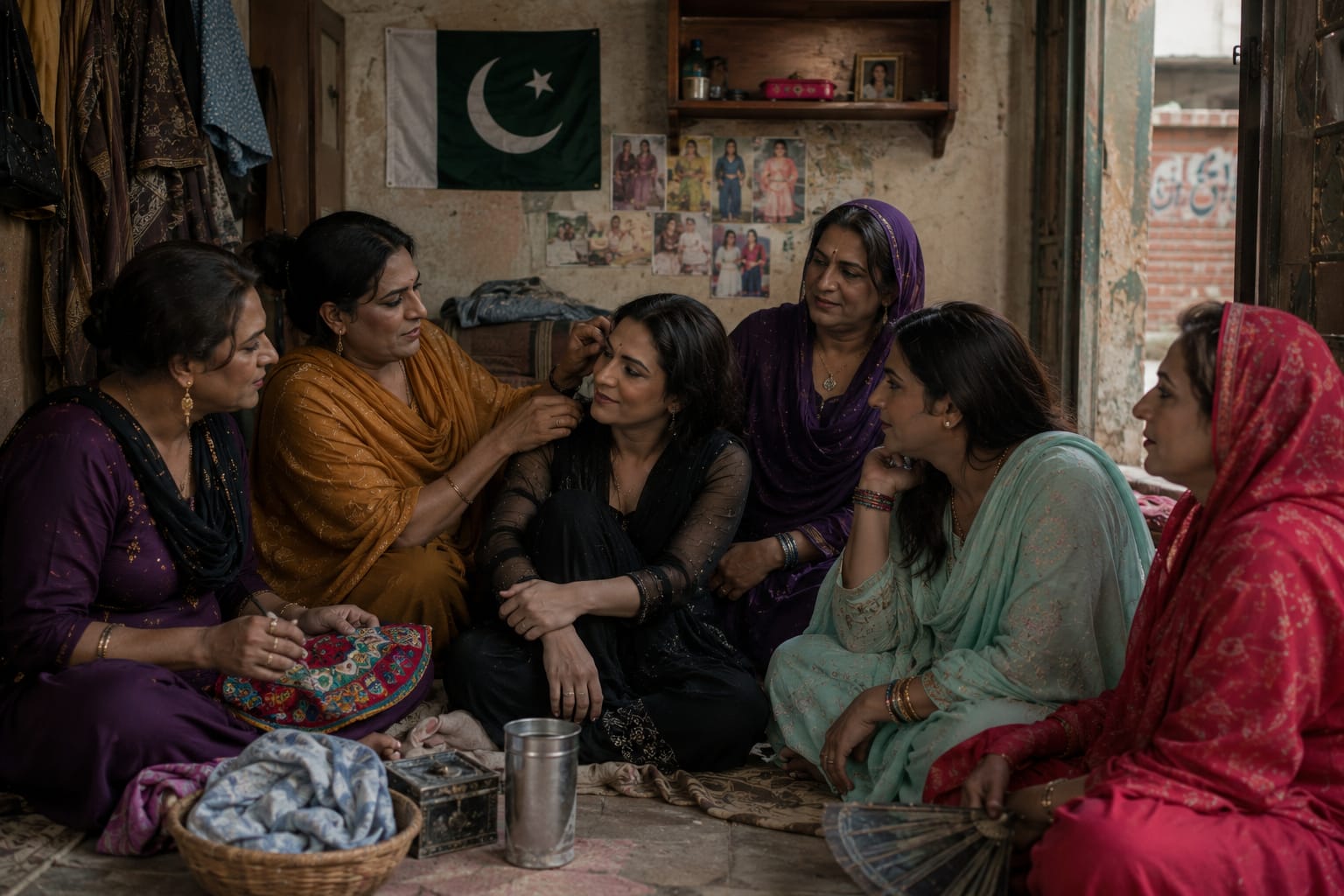

Long before the words transgender or LGBTQ+ entered public conversation in South Asia, Khwaja Siras had already built communities rooted in care, dignity, and survival. Our history is not a recent one. It stretches across centuries, carrying memories of royal courts, Sufi shrines, neighbourhood gatherings, and chosen families that protected one another when the rest of society often turned away.
One of the oldest and most enduring institutions within Khwaja Sira communities is the Guru–Chela system.
To outsiders, the words “Guru” and “Chela” are sometimes misunderstood. They are often reduced to a hierarchy or viewed only through the lens of economics. But for many Khwaja Siras, these words represent something much deeper: a chosen family created when biological families could no longer offer safety, acceptance, or love.
A Guru may become a mentor, parent, teacher, advocate, and protector. A Chela is not simply a student but someone welcomed into a family built on shared responsibility, cultural traditions, and mutual care.
For many transgender people in Pakistan and across South Asia, the first time they hear their chosen name spoken with respect is not at home but in a Guru’s household.
The Guru–Chela tradition has deep historical roots.
Historical records describe Khwaja Siras serving in the courts of the Delhi Sultanate and later the Mughal Empire. During the Mughal era, Khwaja Siras often held trusted positions as royal attendants, advisers, guardians of palace spaces, administrators, diplomats, and custodians of royal treasuries. Their responsibilities reflected the confidence placed in them by rulers rather than the stereotypes often associated with transgender communities today.
Although today’s Khwaja Sira communities are very different from the royal courts of the past, the values of trust, mentorship, and collective responsibility continue to shape community life.
Following the decline of the Mughal Empire and the expansion of British colonial rule, the social position of Khwaja Siras changed dramatically. Colonial laws and surveillance criminalized and stigmatized communities that had once occupied respected social roles. This legacy of discrimination continues to influence public attitudes today.
Against this backdrop, the Guru–Chela system became even more important.
When families rejected transgender children, Gurus opened their homes.
When employers refused to hire Khwaja Siras, communities pooled resources to survive.
When hospitals, schools, and government institutions failed to treat transgender people with dignity, Gurus and senior community members often became the first people to provide guidance, emotional support, and practical assistance.
I have witnessed these traditions throughout my own life.
I have seen Gurus collecting money so that a young Chela could continue her education.
I have watched community members stay awake all night beside someone receiving HIV treatment because no biological family came to visit.
I have seen Gurus organize food, clothing, and temporary shelter for transgender people forced to leave home after violence or rejection.
These acts rarely appear in newspapers.
Instead, the public often sees only weddings, traffic signals, or sensational stories that ignore the compassion and solidarity within our communities.
One memory remains with me.
I met a young Khwaja Sira who had been forced to leave home after her family rejected her because of her gender identity. She arrived with only a small bag of clothes and nowhere to sleep. A Guru welcomed her into the household, introduced her to the community, helped her obtain healthcare, and encouraged her to continue learning. Years later, she had become an advocate supporting younger transgender people facing similar experiences.
This is the Guru–Chela system at its strongest—not merely preserving culture but transforming despair into possibility.
Of course, like every social institution, the Guru–Chela system is not without challenges.
Communities are shaped by the same inequalities that affect the wider society. Economic hardship, discrimination, limited employment opportunities, and unequal power dynamics can create difficult situations. Acknowledging these realities is important, but they should not erase the many relationships built on respect, care, and shared responsibility.
Today, the Guru–Chela system is evolving.
Many Gurus encourage higher education, professional careers, entrepreneurship, public service, and artistic expression. Increasingly, young Khwaja Siras are becoming lawyers, teachers, researchers, artists, health workers, and human rights defenders while maintaining strong ties to their chosen families.
This evolution reminds us that tradition is not fixed. It grows alongside the aspirations of each generation.
As a Khwaja Sira, artist, and human rights advocate, I have experienced the strength of chosen family in moments of both celebration and crisis. I have seen transgender communities organize emergency shelter, accompany one another to hospitals, celebrate achievements, mourn losses, and defend one another against discrimination. These are not isolated acts of kindness—they are part of a living culture of collective care.
The Guru–Chela system teaches us that family is not defined only by blood. It is also created through trust, shared responsibility, cultural memory, and unconditional support.
In a world where transgender people continue to face exclusion, this tradition reminds us that survival has always been collective.
Our future should not require choosing between tradition and progress. We deserve both: the wisdom carried by our elders and the freedom to shape new possibilities for the generations that follow.
The history of Khwaja Siras did not begin with discrimination, and it will not end there. Our story is also one of leadership, resilience, creativity, and community. The Guru–Chela system remains one of its most enduring chapters—a testament to the power of chosen families and to the belief that every person deserves a place where they are welcomed, protected, and loved.
Leave a Reply